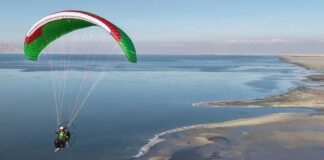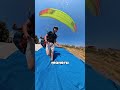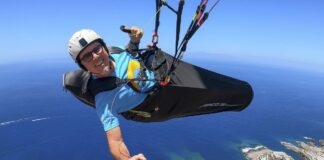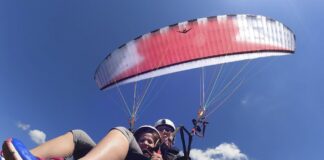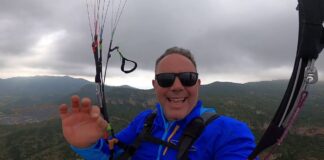
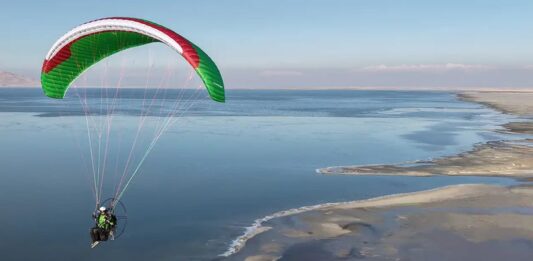

The seventh generation of the progression model from Swing comes with solid arguments to arise as one of the most interesting gliders of its class at the moment. We tried it and enjoyed a surprising performance in sink rate and glide, along with nice handling and progressive turn.
Certified EN A in normal flight, i.e. school or beginners level, and EN B (easy intermediate) accelerated, the Arcus 7 offers the same high level of safety of its predecessors, but a more sophisticated design -that incorporates nylon rods in the leading edge, reduced line length and diameter, and mini-ribs on the trailing edge-, confer it high performance and a good level of comfort in flight.
Its ability for thermalling and an uncomplicated control make it a perfect wing to progress or enjoy cross country flying, and a wing that 90% of the pilots could fly.
The performance-intermediate model from the German manufacturer has just passed EN B certification in size M, with the other sizes following soon. It is a completely new concept with slightly reduced aspect ratio, “sharknose” leading edge, and reduced lines, for “EN C performance with EN B safety”.
The Mistral 7 is aimed at the ambitious XC pilot “of the standard class, but also talented pilots from the low-end EN-B range”, say at Swing. According to the manufacturer, it is a very stable wing that combines impressive glide performance with pleasant handling, maximum rate of climb and very high passive safety. It has aspect ratio of 5.5, 3 risers and only 2 lines per side and level, and a new form of the canopy. Other advantages of the Mistral 7 mentioned by Swing include maximum glide performance with very flat polar curve, very efficient and smooth accelerator that gives “huge speed increase”, balanced pitch stability, calm and comfortable in flight, and well controllable spiral behavior.
The last CIVL Plenary approved the implementation of a new CIVL-EN Competition Class (CECC) that will be mandatory in FAI1 comps from 2015. The competition gliders will have maximum aspect ratio of 7, max speed limited to 65 km/h, and will pass certification tests using competition harnesses and pilot input.
The CIVL Plenary approved almost unanimously this new CIVL-EN Competition Class (CECC), which will have simplified certification tests to make the procedure faster and cheaper, thus opening the way to certification of gliders of all size, in their opinion. The CIVL agreed that limitation on aspect ratio will also “encourage more manufacturers to produce competition gliders”.
Regarding the certification tests, only in-flight tests will be performed according to EN D standards, but at maximum weight only. The official test pilots will use their input to control gliders in an induced maneuver after 1 second, and the tests will be performed in a configuration flown normally at competitions (speed harness).
All paragliders models must be commercially available 90 days prior to the start of the championship. These characteristics and procedures will be revised every 2 years.
The CIVL also introduced a new rule for competitions regarding “End of Speed Section” with altitude bonus, which associated to the new Competition Class should give “more importance in wing design and pilot strategy to best glide performance (instead of maximum speed)” according to the CIVL.
The new Comp Class regulation will apply to FAI1 events from January 2015. For category 2 events, each country’s Aero Club will decide which rules are appropriate for their events. The 2013 and 2014 seasons will be run with the same gliders: EN certified without additional limitations.
Other changes introduced for FAI1 competitions by the CIVL include the requirement to carry 2 reserves (one on each side), or a single reserve parachute that can be easily deployed by either hand even in degraded flying conditions (spin, etc.), from May 2014; and the mandatory use of Live Tracking in all Cat 1 events.
They also decided the site for the 2015 World Championship: Roldanillo, Colombia, from January 10th to 25th.
The largest festival dedicated to paragliding in Spain will be held for the first time in spring this year, following a repeated request from pilots and professionals. The aim is to enjoy better and more pleasant conditions during the day both for flying and for staying at the fair. The 14th edition of FIA El Yelmo will host the 2nd Acro competition “Monumental Acro” and a Spanish Paragliding League event.
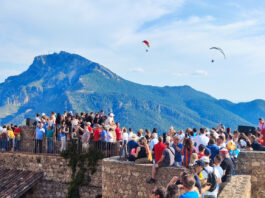
One more year, the International Air Festival of El Yelmo will come with a program packed with activities, competitions and shows in the skies of the Sierra de Segura in Jaen (Andalusia).
One of these will be the "Monumental Acro", successfully held for the first time last year, in which international pilots will display their best tricks and acrobatic sequences before the unique setting of the castle of Segura de la Sierra.
For the first time a BASE jumping competition will take place at the FIA, and also a meeting of "classic" (old) wings, which will certainly be interesting for paraglider pilots.
Among the activities that will come back is the "Paramotor Freestyle", for 6th year in a row, and a training meeting of the Spanish Paramotor Team with a view to the 1st World Championship of Slalom, which will be held in France. The trails of El Yelmo will see a new Para-mountain race, a mountain Raid, the 3rd BTT March, and the 3rd Hiking.
The sports centre of the village of Cortijos Nuevos will be the meeting point for pilots and paragliding professionals at the Fair of the Air, where there will also be conferences, workshops and activities for children, and the popular FIA evenings of films and concerts.
FIA’s organization explains that these new dates are usually "excellent" for free flight in El Yelmo, so they will take the chance to host a competition of the National Paragliding League at the same time. "This way we will join efforts to make both events larger and help in their economic viability in years of crisis and difficulties to find support", they say.
El Yelmo Festival are updating their web site with the program for this year, which will be soon online. The bases for the 14th Air Cinema Festival are already available on: http://fiaelyelmo.com/
Last year, a team of paraglider pilots broke the distance record for vol bivouac flying in North America: 800km across the Sierra Mountains in California. This video is a collection of some of the best photographs taken during the journey, well narrated by one the adventurers.
"A highly engineered piece of fabric, some impossibly skinny lines, a harness big enough to hold some emergency gear, food and water, a radio, gps, vario, a sleeping bag and a mountain range in California that stretches over 800 kilometers. And a few knuckleheads who think it's possible…"
Six pilots at the start and only 3 at the end, after 18 days with 7 bivy nights and 13 days flying over wild, sometimes remote terrain and stunning landscapes, at altitudes often exceeding 5000 meters. The Sierra Safari Paragliding Expedition not only broke records for US's paragliding sport, but was also a true adventure that had abaout everything –from encounters with bears to an accident.
Overall, an amazing experience.
The ultimate security system conceived by Raul Rodríguez and developed with Sup'Air is a freestyle-acro harness equipped with two reserves; the main one is a "square" BASE jumping parachute that opens automatically –after releasing the glider- and the secondary is a Rogallo-type Beamer 2. We tested it at Las Candelas meeting from a tandem paramotor flight, with Raul himself at the handles. The video has English subtitles.
The experience was simply great and highly recommendable. After a short briefing where Raul explained us the procedure and characteristics of the Base System, we prepared to take-off. For the flight we used a paramotor Airfer Polini THOR 200 and a brand new tandem paraglider GIN Safari, which flew for the first time in this exciting test flight.
The power of the engine, a good breeze and the round terrain allowed us to take off very easily; we climbed comfortably at more than +1 m/sec. During the ascent we were placidly talking and when we reached about 400m above the ground I decided that we were high enough. Raul gave me the go-ahead and I "freed" myself by pulling the reserve handle.
The sensation is strong: it is quite impressive to fall into the void, at least the first time, but everything happens fast – so fast that I hardly had time to realize I was diving when I was already reaching for the parachute controls. It is a 22m2 parachute for BASE jumping; the controls are set to "middle brake" position so that if you release yourself very low you will touch the ground not too hard. We saw that 30 meters are enough for the parachute to open and stabilize. Then, it is like handling one of the old paragliders we used in the early 90s, you have to use long brake travel to turn, and it is important to keep in mind that it has a short glide ratio. Finally, you must ‘flare’ it much earlier than you would normally do with your glider.
The Base System guarantees really quick opening because when you release the paraglider, in this case from the tandem, and the harness gets free from the karabiners the container is still attached to one of them by a strap which will instantly deploy the parachute at the moment of the fall. The system is foolproof unless you have fallen in the sail and for such a case there is an extra reserve under the seat, in this case a steerable Rogallo-type Beamer 2, since in Raul’s words, you can’t have total confidence in a round parachute. "Here, in controlled conditions any parachute may be good but in an actual emergency situation the ground is full of hazards, like power lines, buildings, water, etc..."
After this first "base jump" I wanted more! I think that this system, besides offering security at unprecedented levels, it is also a playful device that will thrill many of those who try it. I’d say that it may even be a good idea for a group or a club to buy a Base System and arrange some test flights in a controlled environment for the members, who will very probably enjoy it big time…!
The latest generation of the acro wing from the German manufacturer, the Thriller X3, has completely new designed cell openings and “innovative” valve technology for unprecedented stability in acro models, according to U-Turn. They have also released a tandem version, the Twinforce X3, to be sold only to pilots “skilled enough” to fly it.
Nine prototypes, dozens of line sets, hundreds of test flights and thousands of tricks were necessary to achieve the Thriller X3. It comes with new designed cell openings for better and faster inflation in all wind conditions, and new valves spread over the span to keep internal pressure longer “even in crazy angles of attack”, according to designer Ernst Strobl. This makes the shape of the wing totally different in flight, for example, in helicopters the wing is completely filled and pressurized, explains Strobl. The Thriller X3 also incorporates plastic rods on the leading edge (PPN); its aspect ratio is 5,62 and it has 50 cells. It performs all the current acro maneuvers with “ease” and improved direction stability, according to U-Turn.
The Thriller X3 is available in 9 sizes, from 15 to 24,5m2, covering weight ranges from 50 to 140 kg.
The German manufacturer decided to release for the first time a tandem version of it, to be sold only to “skilled” acro pilots. The Twinforce X3 comes after acro ace Pal Takats has successfully completed over 10,000 infinity tumbles with a proto tandem wing based on a Thriller2K11, and “many” inquiries for a tandem acro-wing received by the company. They feel confident that the new features of the Thriller X3 give the extra safety needed for a tandem acro glider. “The high-tech features of the wing offer a lot of reserves to push the wing to the perfect dynamics”, say at U-Turn.
The two long-standing paraglider manufacturers have signed an unprecedented collaboration agreement for development and production of their wings, but promise that they will “retain their independence” and “will continue in the market”. The partnership will even extend to their respective productions facilities in Hungary and Vietnam, which will be jointly used and coordinated.
Nova and Advance aim to strengthen their development potential resulting in “even better” products for pilots.
“In recent years Advance and Nova have both made their marks on development in the paraglider field, with harnesses as well as wings. Both businesses have very similar visions and concepts as far as the future of the sport of paragliding is concerned. Each development team will retain its individual personality, but in future will seize the advantages to be gained by concerted development, the use of available analysis tools and an exchange of detailed know-how”, declared the companies.
The coordinated used of their factories will enable “greater flexibility, and an ability to absorb production demand peaks”, they say, and add that the cooperation is to strengthen both companies: “Advance and Nova have been recognizable market brands from the beginning, established since the end of the 1980s. The two companies, based in Thun (Switzerland) and Terfens (Austria) will remain 100% standalone. Company model series, marketing and sales activities are to remain completely separate”.
This EN B model from the Brazilian brand is a new development that offers precise steering, stability and high passive safety. Aimed to complete the entry-progression range (classes A and B) of the brand, which now has 4 models, it sits between the Prymus (A) and the Ellus 4 (B).
The Super Final held in Roldanillo, Colombia, concluded on Saturday Jan. 26, after 9 valid tasks and an amazing total of 832 km flown in them, a record for a PWC event. The young Italian pilot took the victory flying the new EN D competition glider from Gin, the Boomerang 9, ahead of Michael Maurer (CH, also on a Boom 9), Russel Ogden (GBR, Ozone Enzo) and local hero Julian Carreno (Ozone Enzo) 4th.
From May 29 to June 2, the seventh edition of the popular festival of freestyle paragliding and acro close to the ground will take place on the Dune of Pyla, France. After a pause of four years, the Wagas Festival returns with the intention to be a bi-annual event and attract lovers of the most dynamic type of flight.
The French manufacturer announced the EN A certification of the second generation of their light glider. The Dolpo 2 has a slightly lower aspect ratio of 5,2 and it is intended for hikers and flyers “of all kinds”.