
Archive: May - June 2004
Go to current page NEW PARAGLIDERS

REPORTED: Gradient BiGolden; Advance Omega 6; Independence Excalibur; XIX Form 3; SKY Metis; Windtech Tempus & Tactic; Gin Zoom; ; Sol Ellus; UP Sherpa 2

If you want to reproduce any information or images from this website, you must ask us by email first. We will generally ask you to credit Ojovolador.com and add a link to our site. Thank you!
© Ojo Volador 2002-03. All rights reserved.

All the news in
FLYING WORLD.
Go!


JUST CERTIFIED BY THE DHV

-Advance Omega 6 (DHV2-3), 25, 27, 29
-Swing Mistral 3 (DHV1-2), 30
-Airwave Sport 2 (DHV1-2), L
-Paratech P80 (DHV2), SM, ML, L
-Icaro Cyber 2 (DHV1), L


ojovolador.com:


Flying World
Our news section, updated periodically to keep you informed.
Check it out!


Gradient BiGolden
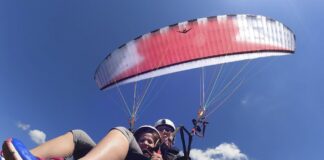
Performance and ease of use are the main virtues of the new tandem glider from Gradient, based in their successful DHV 1-2 model, Golden. Compared to the solo, the Bi-Golden offers slightly better performance and speed, keeping its safety characteristics. Construction features include partial V-rib technology and internal stitching, split A-risers for big-ears, and risers with trimmers. According to the Czech manufacturer, the Bi-Golden offers easy inflation and ground handling, low brake pressure, “excellent” take-off behaviour, comfortable handling and climb rate, “extremely good” passive safety, a wide speed range and good flare for easy landings. “The BiGolden is especially well suited for cross-country flying” say at Gradient. We had the chance to demo one at Castejon de Sos where we found no problem thermalling and gliding with more advanced solo gliders, in a 78 km task. It’s a live wing that gives good feedback while still being very stable. It’s available in 2 sizes, 34 and 42.
+Info: www.gradient.cx


Advance Omega 6
Before the official release of the new Omega, the protos had already won competitions and broke an alpine record in the hands of factory pilot Chrigel Maurer (320km). The new perfo model from the Swiss factory has so shown its “XC Spirit”. According to Advance, the Omega 6 offers easy take-off behavior, a “highly developed steering precision in combination with perfect brake pressure”, a high passive security level, a very flat polar, and “optimal” performance in thermal flying. It has an aspect ratio of 6 points, trim speed of 39k/h, and maximum speed goes up to 55k/h, according to the factory. “The typical Omega 6 pilot is a performance oriented frequent flyer that has a cross-country background”, say at Advance. The new Omega comes in an attractive color scheme, and it’s available in 3 sizes.


+Info: www.advance-gliders.ch


Independence Excalibur
The new perfo glider from the independent factory has been recently certified DHV 2-3 and will replace the Radical. Its design has been oriented to provide the highest performance but offering a good natured behaviour in flight, together with a light and defined handling.
The design of the Excalibur has optimized the performance from the Radical and also its acrobatic abilities. “Anyone who has turned the Excalibur into a dynamic SAT knows exactly what we are talking about!” claim at Independence. The glider, named after King Arthur's sword “because of its sublime and majestic shape when crossing the sky”, has a maximum speed of 58k/h, an aspect ratio of 6,03, and it’s available in 3 sizes.

+Info: www.independence-world.com


XIX Form 3

The new DHV 2 glider from XIX is a performance-oriented model that offers good levels of passive safety, a good overall feel, and “unbelievable” launch behaviour and handling, according to the manufaturer.
It has an aspect ratio of 5,7, trim speed of 36 k/h and maximum speed of 55 k/h.
The Form 3 has been constructed in Toray Nylon 6,6 fabric that offers good resistance to porosity “after years of intensive use”. XIX offer a 3 years/300 hours warranty for all their gliders.

+Info: http://www.xix.ch


SKY Metis

Following the renewal of their corporate image and gliders’ color design, the Czech factory is now introducing a new tandem glider for their range, the Metis, which will replace the Golem. The Metis has been certified Afnor Biplace and its designers claim it has a very easy take off even in no wind or slight tail wind conditions, “generating immediate lift”. Other features include easy handling and light brake pressure, especially for professional tandem pilots; and a good landing behaviour “with enough flair to compensate all small misused brakes of the pilot”, according to Sky. For the outer surface, the factory used New Skytex 9017 cloth with E77A coating, water repellant and resistant to abrasion and UV rays; and the same cloth with E38A coating for the inner sail. The lines are Edelrid (different diameters). The Metis has a weight range of 140 to 210 kg, 56 cells, an aspect ratio of 5.1, and a trim speed of 38 k/h or 45 k/h with trimmers open. Each glider features the new distinctive color scheme of Sky, and is delivered with the new Porter bag and a "Sky Team" T-shirt.

Info: www.skyparagliders.cz


Wintech Tempus

The Tempus is the new model to replace both the Tonic and the Coral as a first glider in the Windtech’s range, and it’s currently completing the certification process for its 4 sizes. The brand’s designers say it is a glider with a “perfect” inflation, suitable for training and progression. “It is so forgiving that the Tempus always comes up impeccably, straight above the pilot's head, even when the pilot's preparation is incorrect. Performance-wise the Tempus is also one step ahead on the Tonic, even though the construction has neither V-ribs nor a larger number of cells. Simplicity is the key”, say at Windtech. The new model has a completely new profile, thicker near the leading edge, towards the cell openings, while in the second half and toward the trailing edge, the profile is thinner “with an important reflex at the trailing edge” for self-stabilisation. The result is a more solid wing that does not surge forward in turbulence or collapses, with a handling very similar to the Tonic’s – “quick, precise and, on the physical aspect, just as light as it was before” according to the Spanish factory.


(after “Tempus fugit”, time flies…)

Info: www.windtech.es


Windtech Tactic

The new racing machine from Windtech, the "Tactic", is already fighting some competitions around the globe. According to Jose Ramon Sáiz, competition pilot and member of the design team at the Spanish factory, the Tactic shows many changes in relation to its predecessor, the Nitro. In the Tactic the profiles are thicker near the tips, helping the glider offer more stability in turbulences and have a better sink rate in turns. Another important change in the new comp glider is a behavior a bit less lively than the Nitro. The Tactic is smoother in its reactions and you specially notice this in the changes of turn -that you have to work up and draw up the trajectory well. Joserra says "to win a paragliding competition you must be able to stay accelerated to the maximum possible; there’s no point in having a fast glider if you can’t keep it fast. With the Tactic we have achieved a very stable glider even when you cross the thermals". The color scheme follows the characteristic style of the brand with a renewed chromatic range.

*In the image of the profile (bottom) we can see the differences between the wingtip of the Nitro (in white) and the Tactic's (in green-red) with more thickness and chord.

+Info: www.windtech.es


GIN Zoom

The much expected DHV 2 model from Gin has finally arrived. The development of the Zoom took the Korean factory more than a year of work and testing, both in the factory and in different sites with good XC potential, like Texas, Mongolia, Switzerland, France, etc. “The objective for Gin was to create a new high performance wing able to swallow kilometres quickly, safely and easily” say the designers, who claim that the Zoom is a “real” XC wing, with competition performance. Its features include easy inflation in all conditions, being “simple to manage during take off”; an easy-to-understand “feel” of the glider in thermal flight and a natural way to combine weightshift and brakes for the best efficiency, according to Gin. The 4 sizes (XS to L) have been certified DHV 2.


Info: www.gingliders.com


SOL Ellus

The Brazilian manufacturer Sol has decided to compete with all the PG brands in the international market and thus the factory has been recently certified by the DHV. Now, their gliders will undergo the German certification as well, and the first model submitted for testing is the Ellus, their DHV 1-2 glider. Intended for beginners and leisure pilots, it’s a “new step in the SOL evolution” and it offers wide possibilities to progress from the first thermal flights to big XC. The Ellus was tested during last year’s record expedition “Nordeste 2003” with good results, making flights of more than 100 km and one of 177 km. The development of the glider was oriented towards a “high passive safety left the pilot concentrating on the flight. Beginner, Intermediate and experienced pilots will feel good flying ELLUS” according to Sol’s designers.
Flight characteristics include easy inflation and ground handling, long and tolerating brake length, precise handling, low stall speed, high internal pressure, light reactions in extreme conditions and good passive safety, and high stability in full speed (according to the manufacturer). Sol guarantees all their gliders for 3 years or 300 hours.


Photo: Sol Gliders

More info: www.solsports.com.br


UP Sherpa 2

The new tandem glider from UP is a brand new design that “has only its name in common with the predecessor, the Sherpa”, according to the factory. They say it’s a glider equally suited for daily professional use and for the performance-oriented hobby pilot “wanting to double his fun in the air”. Features include light weight, small packing, easy launching, and good flare “to a complete stop”, making each landing “a pleasure for both pilot and passenger”. The handling is light and well coordinated and the glider is stable at all speeds, providing good safety margins “to the comfort of all involved”. The Sherpa comes equipped with trimmers and covers a weight range of 130-220kgs. It’s been DHV certified. +info: www.up-europe.com


Photo: Para2000.org

If you want to reproduce any information or images from this website, you must ask us at: info@ojovolador.com first.

© Ojo Volador 2002-2003. All rights reserved. Please respect the rights over intellectual property of this website.
Thank you!