
|
|
| SOL
Ellus |
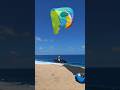
This
is the first glider from the Brazilian factory certified
by the DHV (1-2 in its 4 sizes), and intended for beginner
and leisure pilots, offering them the “possibility
of first thermals to XC flights”. Tested during the “Nordeste
Expetition 2003” (where the tandem world record was
broken) on all kind of conditions, the Ellus appeared as
a good choice for a big range of pilots, offering a high
passive safety, good performance, better handling and safety,
according to Sol.
Its characteristics include a new profile design that gives the Ellus
maximum stability in rough air;
optimized line layout to reduce the overall line length and ease line
checking; Split 'A' riser for big "ears"; and profile reinforcement
in Carbon/Mylar composite. According to the manufacturer, it has a
very easy inflation and ground handling, “excellent” takeoff
characteristic, long and tolerating brake length, precise handling,
low stall speed, High internal pressure, light reactions in extreme
conditions and good passive safety, and high stability in full speed.
SOL offers a 300 flight-hours/ three years warranty with all their
gliders.
+Info: www.solsport.com.br
|

|
| EDEL
MERCURY |
A
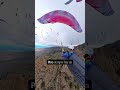
new model for intermediate pilots from the Korean factory,
the Mercury “is designed for and guarantees safe
performance, cross-country flying, due to its excellent
handling in thermals”, according to Edel.
Features include a new diagonal system and safety cell line to ensure
a stable flight, especially in turbulent air, and a special shape of
the cells openings that taper off from the centre of the wing towards
the wingtips “to give the wing its optimum and appealing
aerodynamic shape”.
The Mercury is said to offer ample speed (from 22 to 50 k/h) to penetrate
into headwind and an excellent glide ratio, “whilst the new diagonal
security lines ensure that the leading edge stays open in the most
turbulent of conditions”. Certified DHV 2, it’s available
in sizes XS to L.
+Info: www.edelworld.com
|

|
| Sol
KANGAROO 2 |
This
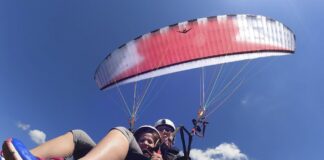
new tandem glider is the one that carried Andre Fleury
and Claudia Ribeiro to the world
distance record last year and it’s promoted as “a
glider made for pleasure”.
It’s a versatile model oriented to offer performance and handling
for recreational pilots or professional pilots and those who want to
fly for records.
The Kangaroo 2 uses a new profile developed from computer
simulated models and in-depth testing. It has 51 cells, 8 closed and
diagonal A, B, C and D bands for “a really clean and precise
glider”.
Compared with the previous Kangaroo, this has a higher aspect ratio
and the cell openings get smaller from the center to the wing tip,
for increased performance. Other construction features include V-ribs,
Profile reinforcement in Diax 120 P Mylar/Carbon Composite, 4 risers
with split As for big ears, reinforced leading and trailing edges with
Dacron tape, and reinforced brake handles with magnetic clip.
It has been certified with 5 cm trimmers.
+Info: www.solsport.com.br
|

|
| Ozone
SIXTY-NINE |
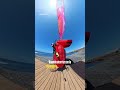
Ozone
have finally released a special glider developed for
Acro flying, the 69. For a long time their intermediate
gliders have been used for aerobatics even in competitions,
but a specific wing for playing with Gs and fast tricks
was still pendant, as their proto Mutant was never ready
for the big market. Now with the 69, the guys at Ozone
feel this is the “ultimate Acro wing”, combining
pure dynamics with extra reinforcements “and
Ozone handling to create a safe wing to perform all those
tricks, combinations and wagas”, according
to the company.
In its development, they kept the best side of the Vulcan for Acro,
it's Sat and Tumbling ability, and they have improved the Helicopter
stability and reduced the brake range and pressure “for easier
Mac-Twist and Misty-Flip”. In brief, everything an Acro pilot
would want in a glider. At Ozone claim that the 69 even has enough
performance to glide from launch without losing “much precious
height” or climb efficiently in a thermal to regain height after
each session.
The Sixty-Nine is being certified DHV 2-3 and it is available in one
size covering a weight range of 70-100kg.
+Info: www.flyozone.com.
|

|
| Wings
of Change NEMESIS |
The
last glider for the Wings of Change range is the DHV
1-2 Nemesis, to replace the Taifun. The most relevant
feature in its design is the introduction of a flap system,
quite similar to Skywalk’s jet-flaps, which improves
the glider's behaviour during full stalls and in slow
flight. The system was developed by Michael Nesler, who
already experimented with flaps and openings in the 90s
and used them in gliders like the Freestyle or the Experience.
Now, the technology has been perfected and incorporated
into the Nemesis, to “slow the backward movement
of the canopy during a full stall, thus allowing for
easy, smooth entry and exit of the manoeuvre”,
according to the company. During normal flight the flaps
in the top sail are closed, but when the pilot applies “loads” of
brake and the glider approaches its stall speed the flaps
start to open. “Through round openings underneath
the flaps air flows at comparably high speed to the surface
of the top sail and mixes with the turbulent air flowing
over the top of the profile, thus smoothing the air flow
there. Hence, the stall will be delayed and the pilot
has enough time to avoid an unintentional full stall” explain
at W-O-C. Aanother special feature in the Nemesis is
that all sizes are built exactly the same, except for
their area. The effect of this is that all sizes behave “exactly
the same” under identical wing loading, showing
no differences in performance or reactions. The Nemesis
is available in 3 sizes.
+Info: www.wings-of-change.at
|
|
| Swing
EVEREST |
This
new lightweight glider recently released by the German
manufacturer Swing is intended both for use as a mountain
glider and also for everyday flying. The Everest has
a low weight and volume, “and uncomplicated launch
and flight characteristics” according to Swing.
The company used a 35gm/m² siliconised fabric
developed specifically for this model according to
their specifications, and they succeeded to reduce
the weight in a 30% “compared to gliders with
similar construction”. The design was based in
their beginners glider Axis 3, and the factory also
used a special light kevlar webbing for the risers
and placed some special Nylon bands on the top surface
to stop the fabric slipping in the snow. In flight,
its behaviour is similar to the Axis 3’s: High
passive safety, low tendency to shoot forward, easy
inflation and launching, and a “particularly
forgiving behaviour in connection with the brakes,
without creating a sluggish feeling”. The Everest
is available in 5 sizes and comes with a special light
backpack adapted to suit the needs of a mountaineer-pilot.
+ Info: www.swing.de
|

|
| Swing
MISTRAL TWIN |
The
new tandem glider from Swing is said to combine direct
and energy-saving handling with simple launch and flight
behavior, to guarantee “both high safety and much
enjoyment when flying tandem on good thermal days” according
to the manufacturer.
The glider has a similar design to that of the Mistral 3, with 50 cells,
an aspect ratio of 5.05, and V-tapes system. “The sweepback and
the elliptical form give the wing a lean, sporty appearance and this
is an indication of its performance” say at Swing. According
to them, this tandem glider offers “outstanding” low take-off
speed and very easy launch behavior even in unfavorable conditions.
In flight it has a low, progressive brake pressure, good dampening
and high stability in turbulence. The Mistral Twin has a large weight
range from 135 to 230 kg, and is said to be “particularly suitable
for professional use”.
+
Info: www.swing.de
|

|
|