
PRODUCTS NEWS 2003 
(Archive: March 2003)
Go to current NEW PARAGLIDERS

REPORTED: Nova Phor 2 (Tandem/DHV 1-2); Mac Para Intox (DHV 2); Skywalk Cayenne (DHVed); U-Turn Infinity; Firebird Grid; Ozone Mc Daddy & Mc Daddy Jr.;Aerodyne Jumbe & Yogi; Gin Boomerang III; Pro-Design Jazz (DHVed); Apco Keara (speed); Ozone Vulcan (DHVed); Swing Arcus 3 & Cirrus 3 (DHVed).


NOVA - Phor 2 / Tandem

Nova has recently certified its Tandem glider, Phor 2 (DHV 1-2 / Tandem). In the construction of the Phor 2, Nova has used Gelvenor fabric for the sail and mylar inserts in the cell openings, to "ensure fantastically easy take-offs throughout the course of its life". The factory designers remark its safe flying behaviour and untiring handling, which allows the pilot to "concentrate entirely on the passenger". Some features of the Phor 2 include extensive diagonal finger-rib construction, inside stitching for the top surface, and a take-off weight range of 130 to 220 kg. The test report is published in the DHV website: www.dhv.de

A nice 3-D image of the Phor 2 (and all the gliders of the range) can be viewed in Nova's website, and, as a matter of fact, the site has just won the Free Flight Web Award at the yearly fair in Garmisch (Germany), in the Professional Category. Check it out!


MAC PARA - Intox / DHV 2

The new intermediate model from this Czech factory, the Intox, has finally passed certification DHV 2 for its size 28 (25 & 30 soon to follow, size 22 will not be certified) and it is already available from dealers worldwide. The design was based on Mac Para's perfo model, Magus, and it is said to have a performance closer to this glider than to its predecessor, the Trance. "Compared to the Trance the Intox is much better and easier to thermal, has better performance at low speeds, is more stable and is not as sensitive as the Trance", say Mac Para's designers.

The DHV test reports will be published in the DHV website soon.


SKYWALK - Cayenne /DHV 2 (all sizes)

Skywalk has completed certification for all 4 sizes of their new DHV 2 glider, Cayenne. The range covers lightweight pilots and big ones as well, starting with a take-off weight of 60 kg (XS) up to 130 kg (L). According to Skywalk, the glider has a sensitive handling "combined with very good performance and well balanced safety characteristics" which make it for "an enormous flying fun". The Cayenne "took a flavour" of different R&D processes performed by Skywalk, like research at Daimler-Chrysler's Aerodynamics Test Center, video research with mini-cameras attached to the flying canopy, a careful choice of high tech fibers and "relentless full-hearted" testing. Other features include partially closed cells; reinforcements along the leading edge; diagonal reinforcement connectors and Fingerrib-Construction throughout the canopy (for stability); an original fabric for the sail (water repellent, light-weight & high UV-resistance, according to Skywalk); and a velcro outlet with air-tube for easy emptying of debris. The test reports are published on the DHV website.


U-Turn Infinity / DHV 1-2

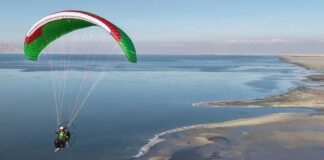
U-Turn is surely the latest Paragliders factory to open its doors to the market. With their premises set in Germany, and an experienced designer behind the creation desk, Ernst Strobl (responsible for paragliders design in Airea from 1996 until 2002), U-turn are debuting with a beginners glider in which they have stated the company's philosophy: "For U-turn, passive security stands in the highest place". The Infinity is said to combine security, performance, fun and aesthetics in a sole glider, and sizes S and M have already been certified in DHV 1-2 (DHV 1, not accelerated), although the test reports have not been published yet. According to the company, the glider has a very wide speed range, from 20k/h up to 52k/h with full speed bar pushed. Not bad for a DHV 1-2. The German company praises its good launching qualities, and performance: "The high stability of the glider in yaw and pitching, even in turbulent conditions, make it very difficult to collapse. The handling has been optimised exactly to take the most from all the Infinity's potential, to make its turn direct and pleasant. But only when gliding against the wind you can feel the full power of the Infinity (aspect ratio 5.21)!". They have more information in their website but only in German so far. English and French versions will be "coming soon", just like their other models for the range: a Tandem, a perfo and a competition glider.


Firebird Grid / DHV 1-2

Firebird's new DHV 1-2 for the year 2003 (successor for the Matrix), the Grid, has recently passed certification. The most interesting design feature of the glider is the circular shape of the air intakes on the wingtips, which has a "significant impact" on handling, glide, speed, performance and safety, according to the design team. This design feature came out after research and tests done with the aid of aircraft development industries. Finally, they concluded that "the most efficient for rammed air and an increase of pressure was with pure round intakes. No paraglider had ever used round intakes until now, Firebird!" say the company's enthusiastic designers. The Grid is intended for recreational pilots and those who want "fun without worries". According to its creators, it has a light, precise handling and reacts to every input given. "It will do the turn the way you want, steep, flat, precise", they say. It has a maximum speed of about 48k/h according to DHV test reports, and at Firebird they believe it is "the next step in evolution of paraglider design".

The company have renewed their website and moved it to a new web address: www.flyfirebird.com


Ozone Mc Daddy & Mc Daddy Jr. - Tandem

Ozone have just certified their new tandem glider for lightweight pilots, the Mc Daddy "Jr", or 41. They decided to make a smaller size for their tandem model in order to offer the pilots a wing "that will best suit their normal pay load, the conditions they normally fly in and the type of flying they do, whether it be purely pleasure or commercial flying". This idea makes perfect sense with Ozone's philosophy: "Size matters!". The weight range for the Mc Dady 41 goes from 130 to 200kg, and the Mc Daddy 44, from 140 to 230kg. According to Ozone, the glider is very easy to fly and launch, with no tendency to overshoot or pull the pilot off his feet as the wing rises. "The handling is pretty bloody good for a tandem. It's dynamic, you can really through it around and the brake pressure is relatively light so it's good fun to fly. Performance wise it has enough. Faster than the Cosmic with a better glide should be sufficient for anybody", says Ozone's designer Rob Whittal. The Mc Daddy 44 will go to certification soon.

Ozone's new DHV 2 model, Vulcan, has also passed certification in sizes L and XL. Now, the only size pending to be certified is the XS. (More details about the Vulcan below).


Aerodyne Jumbe & Yogi

The intermediate glider from the French company Aerodyne (inheritor of disappeared Flying Planet), the Jumbe, has been certified in sizes S, M and L in DHV 1-2, while the XS size passed Afnor Standard (57-68kg). The Jumbe keeps many features from its cousin (FP's) Spirit. According to the design team, leaded by Michel Leblanc, "the brake travel has been increased, compared to the Spirit, and all the feedback we receive say that the Jumbe is also a bit more performant than the Spirit". The factory has also created an extra-large version, called Shani, which will be certified both as an XL solo glider and as a small Tandem (110-160kg).The gliders range for this year includes a school/beginners model, the Yogi, certified Afnor Standard, with 35 cells and aspect ratio of 4,6. Compared to FP's Astair, it has a more progressive launching behaviour, "a bit less physical", according to Aerodyne, and also with a better turn: "the glider rolls easier with the brake, but the stability is better". It is available in 4 sizes, from XS to L. The company are working in the XS size of their perfo glider, Shaman (Afnor Performance in S, M & L), the L size for the competition wing, Blaster (S & M, Afnor Competition) and development of the Dune, which will be their DHV 2 model, expected for this spring.


Gin - Boomerang III

The competition machine for this season is now ready, the third version of Gin Seok's Boomerang, and comp pilots worldwide will soon receive it. The Boomerang III is announced with a better climb rate than the previous Boomerang (II), safer, easier to fly and more stable at maximum speed. "She cuts through the air like a blade cuts through silk", says Gin, the proud father. He concentrated the development of the model on a new profile, a work that has taken 2 years of studies and tests of profiles in the Korean Air Force Academy wind tunnel. Gin gave a lot of attention to the leading edge inlets, now more refined, and developed a different internal structure for the glider, "made with fine adjustments of the panels, tapes, internal ribs, main ribs, diagonal ribs and reinforcements", according to the Korean brand. The prototypes were tested by the factory pilots (Louise Crandal and Jimmy Pacher, among others) during the Europeans and World Cup Tour 2002.


Pro-Design Jazz Certified DHV 1-2

Pro-Design have certified all 4 sizes of their new model Jazz, in DHV 1-2 level, as expected. According to the tests, the Jazz reaches a max. speed of 50k/h. As we reported in our January News, the glider features reinforcement tape along the wingspan; TETS brake-line attachments, supposed to offer a more efficient braking and perfect tension on the trailing edge; and Pro-Design's 'Ram-Air Pockets' on the leading edge "to reduce performance-diminishing vibrations", according to the manufacturers. Jazz is also one of the most lightweight model designed by the company, with about 5 kg. only for the smaller sizes. The DHV tests reports are posted in the DHV website.

Pro-Design has also done a good work with its new website, now easier to surf through and with a fresher look overall. It is available in English and German, and soon, also in Spanish. www.pro-design.at


Apco Keara: A question of Speed

Apco's leader Anatoly Cohn is not happy. His newborn star for the intermediate-advanced pilot, the Keara, was measured a much lower top speed by the DHV than Apco's promises. The company had claimed that the glider could reach a maximum speed of 59k/h, while the certification organ published a humble 51k/h, which they had to correct later saying that the measures were taken with trims closed. Now, the top speed published by the DHV for all the certified sizes is 54k/h, but Anatoly Cohn has expressed his nuisance in a letter sent to Apco's dealers, stating that "DHV officials explained and admitted that their speed measurements do not reflect true, top speed capacity of the glider and they do not aim to record it as they certify Safety, not Performance". And so he reassures that the model does reach 59k/h: "We stand firmly behind our measurements and support them as true, realistic figures. We conducted many comparative speed runs and are faster than many other DHV 2-3 or DHV 3 gliders for which DHV recorded top speeds of 56km/h, 57km/h or even faster". He encourages pilots to test fly the Keara by themselves and conduct their own comparisons with other paragliders, paying special attention to speed. He seems to be completely sure that the Keara will win most races. Cohn believes that from now on DHV will avoid publishing top speed figures, "as they are not reliable or objective and should not be used in manufacturers marketing hype". He recommends an article written by Greg Hammerton and published in his website, which, he says, totally echoes Apco's experience regarding the glider's speed and DHV measures: http://www.sahpa.co.za/hammer/speed.htm


OZONE- Vulcan DHV 2 certified

The replacement for the popular Octane has just passed DHV2 certification in sizes S, M, L & XL. The Vulcan is announced as a wing for the true sport pilot, which outperforms its predecesor whilst keeping "the feeling". The glider has a higher aspect ratio of 5,4, a smaller tip area, and also more cells (56) to improve the performance. But the handling is what received the highest care from its creators. "We have spent many hours fine-tuning the Vulcan until we got the feeling and precision we were looking for", says Ozone. They also claim that the Vulcan offers more performance throughout the speed range, "but interestingly it also offers more pitch stability than before". The intermediate model features the brand's B2 tabs (introduced with the Vibe) which are supossed to offer more stability in flight "and reduce the pitching effect even further making the wing very comfortable to fly even when it's rough and turbulent", according to the designers. As the Octane has been an acro favorite, Ozone tried to keep the qualities of agility and manoeuvrability in the new model, and Mike Kung showed they seem to have succeed in this, during the last Bregenzerwald Cup (Austria), in January. The Vulcan will be available in 5 sizes, from XS to XL, and 3 original color schemes.


SWING - ARCUS 3 & CIRRUS 3

The 3 sizes of the ARCUS 3 (24, 26 and 28) are now DHV certified 1-2, with weight ranges that go from 60 to 115 kg.; and they should be available from dealers these days. The Arcus 3 keeps many of the characteristics of its predecessor, but Swing has given special attention to the handling, the launching behaviour, and the performance throughout the speed range. "The ARCUS 3 is a reliable and highly competitive glider for pilots who want to meet the challenges presented by thermalling and distance flying, without placing themselves under any stress", say the designers. The manufacture of this new intermediate glider includes the new fabric used by Swing, the silicone-coated Perseverance PN 6 (44g/m²) for the top surface, a light material highly resistant to UV rays. The glider has 46 cells and a max speed of more than 50 k/h, according to Swing. The new Perfo model, Cirrus 3, is aimed at the "ambitious cross country and competition pilots", and its design was derived from the competition model Stratus 4. Construction features include full diagonal ribs and "a line geometry that reduces drag and is thus conducive to efficiency", according to the German company. They used Perseverance PN 6 for the top surface of the canopy and Toray WT 7 for the bottom surface; and it can be ordered with competition lines made from unsheathed aramid lines. Swing remarks that it has a "very sensitive and precisely defined handling, which gives the pilot constant feedback during flight and an excellent glide potential throughout the speed range". Aspect ratio is 5,8; maximum speed is claimed to be around 54 k/h, and the size 24 has just passed DHV certification 2-3.


Check out January News!


If you'd like to reproduce any information or images from this website, please ask us at: info@ojovolador.com before doing so. Thank you! © Ojo Volador 2002. All rights reserved. Please respect the rights over intellectual property.


home / versión360º / ojovolador / services / look! / Read! / xtras


U-TURN Infinity - DHV 1-2


Firebird GRID - DHV 1-2


Ozone
Mc Daddy & Mc Daddy Jr. - Tandem


AERODYNE Jumbe - DHV 1-2


GIN Boomerang III


PRO-DESIGN Jazz


APCO Keara


OZONE Vulcan


SWING Arcus 3


Check out January News!


      Intox in winter


Ernst Strobl's Infinity


www.flyfirebird.com


For Ozone, size matters!


AERODYNE Yogi - 
Standard 1st glider


SWING Cirrus 3