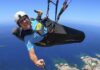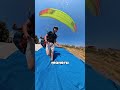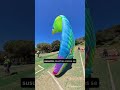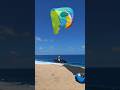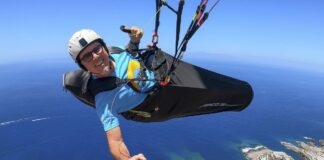

The
Azores Festival is, first of all, a meeting of friends who love
flying. That is at least what the enthusiastic organizer Joao Brun
and the members of the club Asas de Sao Miguel try to convey, without
saving efforts to make the participants fly and enjoy the impressive
views of this beautiful island from the air. So, it is no wonder
that many of the pilots we saw this year are already regular visitors
of the Festival and have the date marked as a must-go annual
appointment and an opportunity to meet again with other flying buddies
from different places who, like them, do not miss the trip to Azores.
A group of international pilots invited to each edition of the “Voo-Fest”
is the way to promote the Festival in and out of Portugal, as the
organization believes that the most effective publicity is person
to person for an event whose aim is to make this attractive flying
destination better known, and to have many happy pilots by the end
of the event.
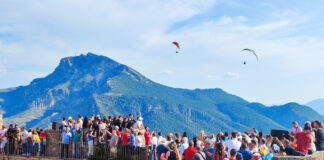
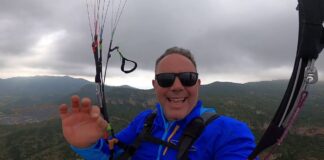
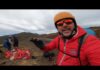
Press conference with some of the Festival's guests
This time the guests were the female champion of France and world
champion, Elisa Houdry, the well-known pilot and
ex- PWC champion Patrick Berod, the Portuguese
top pilots Gil Navalho, Claudio Virgilio, Silvia Ventura
and Eduardo Lagoa, French photographer
Aurelie Cottier, and yours truly from Ojovolador.com.
Pastinhos, a small slope that offers more than what
it seems at first sight.
The
island of Sao Miguel is the biggest of the Azores – that last
remain of land in the Atlantic Ocean where high-pressure with its
good weather usually settles, only a couple of hours by plane from
Lisbon. The landscape is green, scattered with fields where the
cows graze placidly, next to old volcanoes today covered with forests
that descend to lakes and lagoons with smoking fumaroles on their
shores, or to the sea. The length of the island is just a bit more
than 60 km with a maximum width of 16 km, and so from many takeoffs
or with a little altitude you can see both the north and the south
coast.
As
soon as we arrived at Sao Miguel we went to the capital city, Ponta
Delgada, where the organization welcomed us. They had a
comfortable headquarter at the sports port next to the promenade,
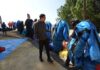
a very nice zone. Every day, this would be the meeting point for
the pilots and departure point of a lively caravan of 4x4 vehicles,
a minibus, several cars and even a moving kiosk with fresh drinks
and sandwiches, that would drive us to the best takeoff for the
conditions of the day. In the night, it would welcome convivial
dinners of the event that contributed to a great extent to the good
ambiance in the Festival –together with the famous ‘caipirinhas’
(a typical Brazilian cocktail) at the square, which some pilots
got so fond of!
On
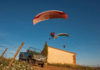
the first day the weather was enough to let us fly –with some
strong wind in the morning– at “Pastinhos”,
almost a school-slope but from where you could soar to then catch
a thermal and climb to the base of some low cumulus. The thermals
were a little broken by the wind, but it was possible to fly and
get a nice view of the North coast of the island. By 3 pm the wind
crossed and the organization moved everybody to another site, Serra
Gorda, only 5 minutes away by car. The ride to the top
of a 200m hill was by 4x4 and the views from the takeoff were superb,
although the wind soon dropped and the slope stopped giving lift,
just when the police came to forbid the flying following a call
from an airline pilot who claimed that paragliders were flying “too
close” (the Festival had all the permissions to fly there,
in any case).
The caravan moved on again and in about 40 minutes we were at Salto
do Cavalo, a viewpoint towards the lake of Furnas on the
east of the island, where we took off over a cliff covered with
forest and about 400m above the landing zone. This captivating site
would host the Festival on the following days, as the weather did
not allow us to try any of the other 20 takeoffs in the island except
on Sunday, when we went to a hill near Sete Cidades
for some top-to-bottoms with a view to the sea. The impressive flight
in the crater of Sete Cidades, just above the lake, was reserved
only for the experienced Patrick Berod with a 20m glider due to
the strong wind.
The
last day ended with a bath in a hot springs by the seaside and a
good celebration around a bonfire at the landing zone of Pastinhos,
with a great ambiance, lots of happy faces, live music, and the
wish to go back next year to the Festival and the island.
São
Miguel - “the green island”. In
its 747 square km, the largest island of the nine that form
the archipelago of Azores displays all the shades of green in
vivid landscapes that are worth taking some days to discover.
There are about 20 paragliding takeoffs in the island and, as
distances are relatively short, you can decide the best site
for the conditions of the day and combine that with sightseeing,
beaches, hot springs, trekking routes or water sports.
For
its geographic location, Sao Miguel has a subtropical maritime
climate softened by the humidity and the warm Gulf Stream,
with average temperatures between 13ºC in winter and
24ºC in summer. The humid subtropical flora has endemic
species and native laurisilva forests. It
is a mountainous island of volcanic origin, as the whole archipelago,
with two volcanic massifs, some small mountain chains and
the highest peak of the island of 1,150 meters (Pico da Vara).
After
centuries, the craters of Sete Cidades, Fogo and Furnas have
turned to mysterious mountain lakes with crystal-clear water
of striking blue and green colours. In the island there is
ongoing volcanic activity revealed as hot sulphur springs
and steaming fumaroles. There is even a regional dish –the
‘Cozido’– that is cooked in a bowl buried
in the hot earth.
São
Miguel can be reached daily from some main European airports
via Lisbon on continental Portugal. During the summer, there
is a regular ferry service linking Sao Miguel and the other
islands.
During
the Festival the organization offers basic accommodation at
two hostels in Ponta Delgada and, although there’s a
wide hotel offer in the island, inexpensive prices can be
hard to find. A good option is to rent a house or apartment,
searching in advance in internet or asking the pilots of the
club in case they know something.
We stayed at a lovely house in the North coast (Calhetas),
about 10 minutes drive from Ponta Delgada, located next to
a cliff where we could hear the waves breaking at night. The
owner is the sister of a pilot and rents the house (an annex
to hers, in the picture) at a reasonable price – with
a double room and a single one, equipped kitchen, a cosy garden
with hammocks and terrace. Highly recommended. Contact: Isabel
Rego, isabel.estrelarego@gmail.com and ph.: + 351 296 650
162.
We tested the new intermediate
glider from Sol, the Ellus3. Comfortable to fly and with good performance,
it left good impressions on us that you will read in detail soon
in our review on Ojovolador.com
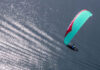
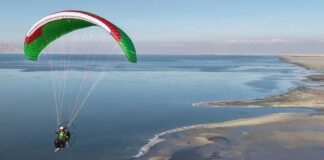
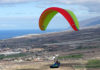
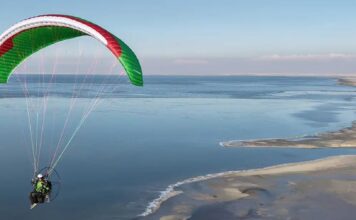
The glide to the lake
of Furnas became a favorite one from Salto do Cavalo.
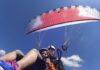
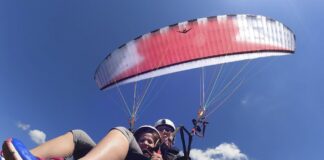
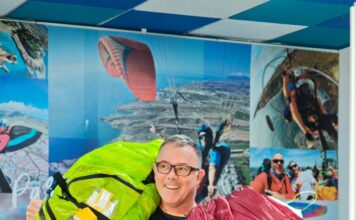
Joa Brun, tireless giving
first flights with the tandem glider
All
the information and images published in this website are property of Ojovolador.com
unless stated otherwise.
Reproduction of any part of these contents (info, graphics & pictures) by
other website or media is strictly forbidden,
unless specially authorized by Ojovolador.com.