
|
The
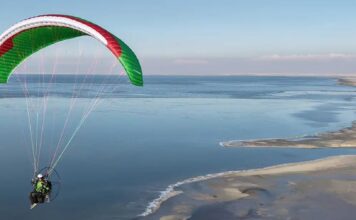
weather gods were on the paramotors side this year in La
Puebla de Los Infantes (Seville, Spain), where over hundred
pilots enjoyed a brilliant day of flying on Saturday 2 of
February and a more limited window on Sunday. Las Candelas
grew bigger this year with a Fair twice the size of previous
editions -even with a bar inside, a space for the pilots
to leave their paramotors at night (with a night watch),
and stands to accommodate practically all the Spanish manufacturer
and the main dealers of flying gear.
Also
remarkable was the security and control at the takeoff and landing
zones of Las Candelas 08. There was an important effort put in
keeping the air traffic safe and organized, with separated takeoff
zones for trikes and foot-launched paramotors and the LZ, a special
area to leave the gear before and after flying, and special maps
of the area with everything clearly marked, as well as advice
given to the pilots of not to fly over the fair. All necessary
improvements over previous editions. The invitation from the
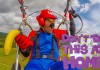
organizers to fly with disguises was accepted by several pilots
and even groups, who showed their good humour and originality.
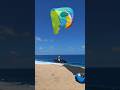
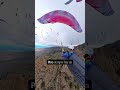
On Saturday many pilots took advantage of the beautiful sunny
day for doing cross country flights, including one organized
by the Club of Dos Hermanas (Sevilla) –who came flying from their
airfield, and also collaborated with the organization. We also
saw a number of pilots from the UK (many of the Lemmings Club
and national champ Michel Carnet), Portugal, France, Greece,
etc.
Video-report:
The manufacturers tell and show their latest features or machines
at Las Candelas 2008 - it's in Spanish, but the images will
tell you something...
By © Ojovolador.com (all rights reserved). Look!:
The
success of the event can be specially noticed in the interest
from professionals who came from all over Europe to the Fair to
see what it is being made in Spain, and to close business deals
with Spanish companies. Spain is a reference in the world of powered
paragliding, both at a sportive level with three world champions
(Ramon Morillas, Daniel Crespo and Nino Muelas) and in manufacture
of paramotors – there are at least 4 internationally renowned marks
and a few more coming out. This, together with the mild weather
of the south of Spain in February, attracts pilots and entrepreneurs
from other countries.
Not surprisingly,
we saw Mateo
Vitorazzi from Italy, who visited
the manufacturers that use Vitorazzi engines (Fly 100 and Easy 100)
in their units (Pap, Airfer, Fly Products); or the guys from Helix propellers
(Germany), that work with almost all the Spanish manufacturers providing
them with carbon props. Also there was, like other years, Pascal
Campbell-Jones from Paramania -the pioneering brand in the
use of reflex- with their local dealers Kasana and Dani Martinez,
and showing some amazing videos of Paramotoring around the world.
From the Czech Republic came Zdenek Andrlik, from Cirus,
to introduce and commercialize a self rescue emergency flotation
device for use with paramotor, which inflates in just a few seconds
thanks to a compressed-air cartridge. They plan to release one specially
designed for trikes soon. 
As
usual in Las Candelas, the paramotor manufacturers had a number
of new features to show [See VIDEO
above].
Kobrappg was
the big news this year, a new manufacturer company led by Leandro
Vega, -known in the Spanish community of microlights for his
company Aeroshop-, Jose Luis Dominguez and Mathieu Dottori.
Kobrappg are making a clear bet for high quality machines ‘made
in Spain', with fine details of original design and prices
for the high segment of the market. Their first model is called
Snake, powered by a Sky 100 water-cooled engine and available
with propeller of 122cm (three-blade carbon) and 125cm (two-blade
wood). Their second model is the Rocco, a more powerful unit
powered by a Simonini Mini 2 plus, with their own reduction
gear and exhaust system. To name some features, the Kobrappg
motors come with curved arms made of aluminium alloy, a throttle
of original design with cruise control easily deactivated just
by pressing, parachute container under the seat and a compartment
big enough to accommodate food and drinks for long cross country
flights.
The "traditional" manufacturers
also had news to show:
PAP already have their entire range equipped with the new aluminium arms certified
by the DULV, without shackles, and originally constructed for ‘acro' pilots
thus able to resist the most dynamic manoeuvres. The new sealed fuel tank of
12 litres was also introduced in all Pap models. Pap have a choice of 4 paramotors,
from the light Top 80 to the powerful Fly F200, with the Vitorazzi Fly 100 and
the Ros 125 in between. Of these, the latest additions are the Fly 100 and the
F200, with customized features introduced by the manufacturer leader of the
market.
Their
own version of these two engines offer Airfer,
that also keep a strong work on the Paratrike side of the sport
which has given them a world title in the hands of Daniel Crespo.
This year, Airfer introduced their latest project: a 4-stroke
unit called ForT-400 that will power a trike (solo or tandem)
with the advantages in consumption and noise provided by the
4-stroke engine. They also introduced their paramotor VR200 Micro
(Fly 200 engine) aimed at schools or beginners, with a cage of
only 107cm of diameter and four-blade propeller of 94cm, which
make it easy and comfortable to handle on the ground for medium
to large new pilots –to use
foot-launched or on a trike One- keeping a high thrust.
H-E
Paramotors presented
their new model of modular chassis totally divisible in many
parts and created to facilitate its transport in a suitcase
or any car trunk, with pieces that can be easily replaced.
This model is available in aluminium and steel, and tentative
name is Samsoflite. They also showed a new integral trike – not
a paramotor mounted on a trike- very easy to disassemble to
fit in a normal car. H-E continue manufacturing their own engines
R80, R120 and the most powerful R200, already in production
and available with manual and electric start.
For
Clemente the news was their trike Securemax, suitable for solo
or tandem flight with no need to reset the hangpoint, which offers
low centre of gravity, suspension system in the axes and great
stability, powered by a Simonini Victor 1 plus engine of 48 HP.
They continue with the Raket range, light and reliable, available
in several sizes of propeller-cage and manual or electric start.

Kasana,
dealer of Fly Products in
Spain , brought their range of paramotors with new hangpoint
system (low h-p) to improve piloting and comfort in flight, and
a refreshed look with new choices of colours for the net of the
cage. The engines used are the Vitorazzi Fly 100, their most
popular unit, and the powerful Simonini for large pilots. This
engine also powers the Flash trike, of compact design and suitable
both for solo or tandem flights.
Next
to them was Dani Martinez introducing his new company
of flying tourist services and rent of paramotors, Olivair,
and also the new dealership for Spain of the Miniplane (from
Per il Volo, manufacturer of the successful engine Top 80), perhaps
the lightest paramotor in the market with just 18.5 kg empty,
modular chassis of aluminium and glass fibre, and propeller of 115
or 125cm. Dani and Kasana share the distribution of the Fly Products
paratrikes (Flash, Eco 2 and Eco 4) in Spain..

El
campeón inglés Michel Carnet, a punto de despegar
con un Miniplane que lleva una hélice prototipo de Helix.
Finally,
outside the official Fair we could see some prototypes like the
one made by Juan Santos of Helices
Juanbur, who has decided to
recover the veteran engine Solo –although in its latest version,
updated to the present times- with a new exhaust pipe that provides
more power, and a propeller of 1,20m. This personal project of
Juan is also applicable to old Solos that might be still running
out there, which can be upgraded to improve their performance.
Regarding
new paragliders, we tried the new semi-reflex model from Mac
Para specifically designed for paramotor: the Velvet. It is a
very dynamic glider, almost acrobatic –although
the high load we had with the trike probably amplified this-,
good fun to fly it fast taking advantage of the immediate response
at the brakes. The feeling is perhaps similar to that of a free-flight
glider in the turns, but with no tendency to surge. This model
is aimed at intermediate pilots with experience and a taste for
dynamic piloting.
We also flew the new Powerplay
Naja, which is a model more intermediate
than the Sting. It is an agile glider with quick response, very
compact and nothing nervous, and with very direct pressure on the
brakes. It is not a reflex wing but the Naja is fast and comes
with long trimmers. It seems to be a glider suitable for a wide
range of pilots.
Other gliders we saw are the ITV
Tsampa (Altairsport), the Roadster from Ozone (Alamair), the Speedmax from Nova or the Alpha
4 from
Advance (Draco) that Ramon Morillas brought with special competition
risers (with much longer trimmers than the original).

*Special
thanks to the organization of the XII Paramotor Meeting of Las Candelas
for their help to produce this article.
More info:
www.lascandelasparamotores.com |
| What's
legal in Spain?

On
the 3 days before the paramotor meeting took place the first
workshops dedicated to analyze and debate
the situation of paramotor in Spain and in Europe, with
talks by people involved in the control of microlights (Police
and Civil Aviation officers), delegates of the French Microlight
Federation as well as specialized journalists of the neighbouring
country, and the paramotor world champion Ramon Morillas,
among others.
It was interesting to learn that there is no specific law
for paramotors in Spain, but that our activity is ruled
by either general regulations or specific rules made for
microlights. The final conclusion was that we need a specific
regulation for paramotors, which means that all institutions,
professionals and people involved in Paramotoring should
agree on a way to work this out. And then, try to make the
Spanish authorities build specific rules for our activity…
(a long hard work).
Meanwhile, if you fly in Spain you should
know that the following rules should be respected
as much as possible if you want to be 'legal',
although common sense applied when you fly should be enough
to keep you out of trouble –the authorities are not watching
us so closely (yet)!:
-
Fly below 300m above ground level, and over 150m
if you are not approaching to land (i.e., we should fly
between 150m and 300m).
- Do
not fly over inhabited buildings, towns or cities
- Do
not fly over groups of persons (on the beach, for example)
- Do
not fly in prohibited or restricted airspace (CTRs
of airports, for example)
- You
must have civil responsibility or third party insurance for paramotor, and accidents insurance for the passenger
if you are flying tandem
- Do
not fly in bad visibility conditions: in clouds or
by night, for example.
- A
pilot's license is not required to fly a paramotor,
only the insurance mentioned above (although a license
might be necessary for participating in PPG meetings
or comps)
*Always
contact the local clubs or Federations to find out specific
restrictions or rules for the area where you plan to fly.

Some
participatants of the paramotor workshops
|

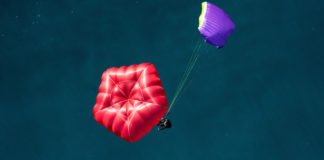
"Puffer", an instant flotation device manufactured in
the Czech Republic specifically for paramotors: for pilots who
usually fly near or over water. In the picture, on a H-E paramotor.
The manufacturer (Cirus) are preparing a version for paratrike.

Nino
Muelas trying the new paramotor Snake from KobraPPG

The
new, powerful Pap F200

Trike
One by Airfer with the new paramotor VR200 Micro, specially made
for schools or those who want a small, comfortable cage.

Dani
Martínez, Paco Burgos (director of Las Candelas), Daniel
Crespo and Pascal Campbell-Jones

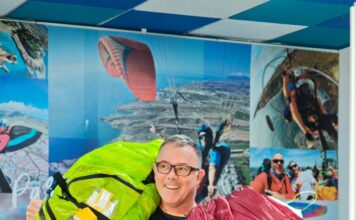
The
best disguises were awarded at Las Candelas 08, and also this
big photographic poster of the world distance record by Ramon
Morillas was raffled off among the participants. Ramon himself
signed it for the happy winner.

There
were many paramotors to try at Las Candelas, and those from
Kobrappg (like this one) called the attention of many pilots.

Arturo
Barcena from Olivair, dressed as a flying spider (the rest of
the legs are on the paramotor), with his wife Ana Belen.

Joaquín
(Daxtrem) and Lodi (Nova) from the Basque country, had the
Nova wings for PPG:
The SpeedMax and the tandem Bigmax, and the gliders for dual
use with special paramotor risers.

Nino Muelas, world champion of tandem paratrike, displaying
his abilities on foot-launched paramotor under an ITV Tsampa
glider.

Ángel
Javier Carrasco and his nephew Alberto Navarro, flying their
original disguise of a chinese dragon


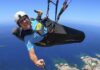
Trying
the new
Mac Para Velvet. See it in action on our video
flying in Las Candelas (higher on this page)

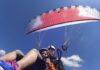
And
trying the Powerplay Naja. See
it in action on our video flying in Las
Candelas (higher on this page)
In
summary, many new features, many options and solutions, and
also more and more trikes in a market that keeps on growing
at the same rate of the sport. We hope that there will be
many more of them next year, as well as plenty of flying,
night bonfires, good atmosphere and lots of fun, don't you
miss it!
|