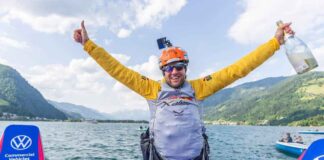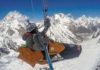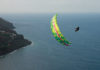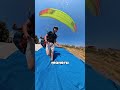

At first, Ramon
had planned to fly an Omega 7 colour "steel" (light-gray & yellow)
but he was strongly adviced to take an orange one for security
reasons.
Equipment
for flying 1350km
above the Ocean
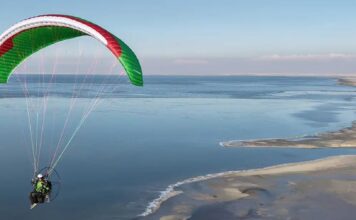
Paramotor: PAP ROS 100, similar
to the one used by Ramon for the distance record done
in 2006, mounted on a specially lightened chassis of
a single piece, with a light harness made by Supair
and 4 fuel tanks (two behind and two on the sides,
for a total capacity of 71lts). Carbon propeller of
130cm (two-blades). Manual start (with kick-down system
to restart in flight), and rescue chute. Empty weight:
30 kg.
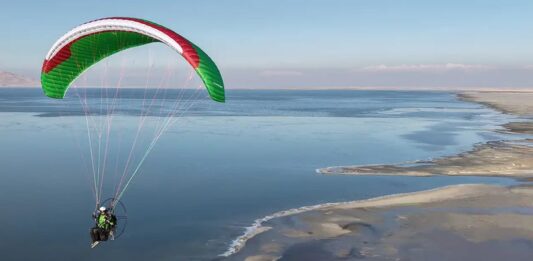
Paraglider:
Advance Omega 7 (DHV2-3)
a
high performance wing that incorporates trimmers for reaching
high speed with comfort. Open Helmet,
with wire connections for cell phone and radio. Stroboscopic light to fix on
the paramotor, in case Ramon has to take off or land by night.
Navigation:
4 GPSs, two Garmin 76, a MLR, and the flight logger to validate the
record, "Volkslogger".
Tracking
systems: To transmit his satellite
position, both for security and to make his flight followed
in real time through Internet, Ramon will carry two systems,
one of Iridium and another DMR-200
of Inmarsat - of 1 kg
of weight with battery for 20 hours.
Security:
Ramon will bring a big semi-rigid rectangular case (also
used as a cockpit) for carrying most of the safety and navigation
equipment. The case will be fixed to the paramotor with two
side bars, and in case of an imminent water landing the pilot
will release it from the Paramotor and fix it to his own
body before jumping out to the water from 1 or 2 metres above
- so that he has the rescue equipment with him. On the surface
of the case, under a transparent cover, all the navigation
devices and transponders will be fixed (and visible for the
pilot), while inside the following
elements will be kept (apart from water and food):
-
Self-rescue boat: inflated by pulling
a cord, it even has a cover to protect the passenger
from the water. Weight 5kg.
-
Radio-beacon: like the ones used by ships for emergencies,
it sends a signal to allow tracking by the rescue services.
-
Radio, aerial band: to communicate with the army helicopter.
- Satellite Cell-phone Iridium
-
Flares, colour tint for the water (to be seen from the air),
light bars.
The pilot will wear a neoprene suit and a 'condom' system for
peeing in the air during the flight. Around his neck he will have an inflatable
life jacket (by pulling a cord), and the paramotor will have another
one for floating and being recovered from the water, if possible.
The
procedure for water landing that
Ramon will follow starts by informing about the incident by radio or phone.
He'll be flying at least 1000m over sea level which gives him 5-10 minutes
to prepare. Then, he'll undo the Paramotor harness straps, put all the instruments
he can in waterproof bags, close the neoprene suit, attach the cockpit-case
to his body and release it from the paramotor, inflate the life-vests, and
get ready to jump out just when he is one or two meters (not more) above
the water, clearing from the glider and the paramotor. Once in the water,
the pilot will have to take the rescue boat from the case, inflate it, climb
inside, and wait for help.
Pilot
weight: 67 kg
Equipment
weight: +-100 kg
Total
take-off weight: about 170 kg
Preparing the record flight
Several
years ago, Ramon and two friends sailed across the Atlantic
Ocean in a catamaran, and it was then when he thought for
the first time that a similar journey by paramotor could
be done. The idea stayed in his mind until last year, when
he proposed it to the organizers of the Paragliding Festival
of Los Realejos “Flypa” as part of the promotion activities
for the 2007 edition –in the first Flypa Festival, Ramon
broke the PPG record of altitude over Tenerife, and in 2006
he flew over the sea from Tenerife to La Gomera (Canary Islands).
"I told them that if I broke the record of distance flying 1000 km,
which I had planned for the summer (2006), we could seriously consider flying
from the Iberian Peninsula to Tenerife. Then, when I had done the record
(950 km) we started to organize the expedition with the city-hall of Los Realejos" explains
Ramon.
Ramon
studied the course to Tenerife and every alternative
route in detail, with Google Earth.
The
first step was to study the meteorological conditions
between Spain and the Canary Islands, and check if a
paramotor could take advantage of the trade winds to
travel at high speeds in south-westerly direction. With
the help of the Canary pilot and meteorology expert Guillermo
de Armas, Ramon concluded that it would be possible,
and they decided that the best time would be during April.
The total distance is 1350 km starting
from the airport of Jerez de la Frontera (Cadiz,
on the South-west of Spain) and landing at the beach
of El Socorro in the municipality of Los Realejos (North
of Tenerife, Canary). A total of +16 flight hours,
only if Ramon finds tail wind of about 30 knots,
and 65-70
litres of fuel.
The
right choice
It will not only be a unique flight over the sea, but also a new world record
of distance for the Spanish sportsman. And it will not be an easy task nor “a
walk in the park", thinks the pilot. Only the planning has taken him and
his team several months and now, while he waits for the right weather to take
off in optimal conditions, Ramon feels serene knowing that he has the most suitable
equipment for such a long flight: A paramotor PAP Ros
100 with carbon two-blade
propeller of 1,30m (slightly bigger than the serial 125cm for the best compromise
between thrust and consumption), lightened chassis and harness, and two
tanks of 13.5 litres on the back part and two side tanks of 22 litres each;
and a paraglider Advance Omega 7 (DHV2-3) size 30, a high performance
model. Add to this a number of safety devices ranging from self-inflating rescue
boat to hi-tech satellite tracking systems (see box on the left), water and
food. Altogether, at the takeoff run the whole unit pilot-glider-paramotor-equipment
will make 170kg, of which nearly 100kg will
be supported by Ramon's back.
Institutional support: This
ambitious adventure would not be possible without the support
of the city-hall of Los Realejos, organizers of the Flypa
Festival;
the Spanish Aeronautical Federation, the Air Force, and the City-hall
of Jerez de la Frontera. These institutions have offered the
athlete unconditional support and belief in his dream of
connecting the peninsula and the Canary Islands by the lightest
and youngest aircraft in the world: the paramotor.
Not
alone
His brother Juan managed to involve other important sponsors for this adventure,
like the Spanish Airsports Federation, the National Air Force and Spain 's SAR
(Search and Rescue service, considered one of the most efficient in the world).
They will take care of Ramon's security during the flight and will rescue him
from the sea in case he falls. This way, Ramon will not fly alone. He will be
escorted by a military helicopter since launching from Jerez
until the aircraft needs to refuel in the afternoon, leaving Ramon all alone
above the Ocean for a couple of hours only. Another helicopter will be ready
to leave from the Canary island of Lanzarote to meet the Paramotor, and an airplane
will fly over the route of Ramon during the day. The SAR will be prepared to
launch a rescue procedure in case the adventurer ends up in the water.
The
flight
If
the meteorological conditions are optimal, i.e., there's north-eastern
wind of about 30 knots during the day and route, Ramon will take
off at dawn and will fly to the South taking altitude until he
sees the Army helicopter. From
there, he will be flying above the sea using only the instruments
and a map for reference, and he'll possibly receive relevant
information from the helicopter by radio or from the rest of
the team via the Iridium phone. His route is not exactly straight;
he will follow the curve of the isobars which is also the course
of the trade winds or ‘alisios'. If the conditions were not
so favourable concerning the wind intensity, Ramon will take
off before 6 am, still by night, to try to gain time and height
above the airport of Jerez –safe
known land- before attempting to fly the distance between the
peninsula and the Canary archipelago in less than 18 hours, the
time there's daylight. If he can't make it, because the wind
changes and alters the course, or because the speed is not enough
to reach Tenerife before darkness, the pilot has alternative
options, like flying to the island of Lanzarote instead (about
200 km nearer, also in Canary), flying to the coast of Morocco
and landing there with no support, or even try an emergency landing
in a deserted isle. The worst scenario would be to fall in the
water by an engine failure or by any other incidence, although
Ramon says he is prepared to face this contingency and believe
that the rescue services would make their work well. But if he
falls to the sea during the last hours of the day things would
be more complicated since helicopters cannot fly by night, so
any rescue operation would rely exclusively on life-boats. Another
scenario would be that Ramon arrived at night in Tenerife, in
which case he would have to use the instruments to find and land
on the esplanade of Puerto de La Cruz, some km from Los Realejos,
a well illuminated and broad landing zone.
Decisions
Ramon, used to big challenges, admits calmly that there are risks involved in
the flight but that it can be done. "The first
three hours are the most critical; I'll have to get used to being alone
there over the sea and lacking all references. Then I will be navigating
and piloting, which is a lot of work, I must be very attentive to consumption
and flight altitude, to fly at between 1000 and 1500 meters. Above the sea
there's lift and sink, there could be a big cloud, or even rain... I will
also have to watch the wind and, at a certain moment, make a critical decision
of whether to continue towards Tenerife if my levels of fuel, speed and
daylight are ok for arriving there before it gets dark. If they aren't,
the alternative is to change the course towards the island of Lanzarote,
which is a couple of hundreds ks nearer. I have to know this for sure once
I have covered 800km, to correct the course",
explains Ramon.
"Doing
such a long flight and over the water may seem insane
to many people or that I'm perhaps taking too many
risks, but we have meditated a lot on this and this
is what motivates me: That it is difficult, but it
can be done! And it is my way to do a small
contribution to my sport; in this sport that
it's so young I like to push the limits a little, to
do my part. I like challenges; to challenge myself,
and I feel really lucky to be able to think ‘what
do I want to do?' and do it, to fulfil my dreams.
The attempt to make this record is what motivates me
the most. Then, if I accomplish it or not will depend
on many factors",
concludes the adventurer.
At
the time of publishing this article, Ramon Morillas was
in Jerez training and preparing the last details of his
journey with the rest of the team. He planned to take off
as soon as the meteorological conditions allowed him, possibly
on Wednesday April 18th 2007. You can follow his flight
in real time thanks to the satellite tracking system at:
Draconexion.com/latravesia and Flypa.es
+
Info
Watch a video of Ramon explaining the equipment he'll
use and how he feels about this flight. It's in Spanish (sorry!)
but it shows the gear and nice sequences of Ramon flying.
Click on the Play icon.
All information and images published in this website are property of Ojovolador.com
unless stated otherwise.
Reproduction of any part of these contents (info, graphics & pictures) by
other website or media is strictly forbidden,
unless specially authorized by Ojovolador.com.
If you want to share this information, please pass the Web address (URL) of
this page.
All rights reserved. Please respect the rights over intellectual property of
this Website. Ojovolador.com
email: info@ojovolador.com
Tel.: +34 920378503
Lanzahita (Avila) - ESPAÑA