
Thermal
Flying
By Daniel Crespo Valdéz.
(Published in the spanish magazine Parapente Vuelo Libre 2002)
Thermal
flying is a desire for every pilot. Thanks to this technique we will be able
to, literally, expand our horizons and begin to discover the true virtues
of free flying. Some pilots concern about the turbulences associated to this
kind of active flying; actually, we have to face the cost of this pleasure
-which in any case is that high. Thermal flying involves some instability
and continuous movements of the air, and it is precisely thanks to these movements
that we can climb up in the sky. We have to learn how to deal with them so
we can pilot to our benefit, and fun!
Position
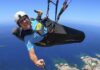
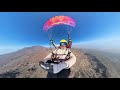
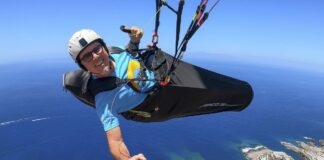
It is necessary y to be comfortably sat on the harness. I like to sit a bit
leaned backwards, with my forearms resting on the risers, and my legs close
to each other as relaxed as possible. Sometimes I use the speedbar pedal to
lay my feet. Crossbraces usually are an "anti-piloting" element and I do not
recommend its use, specially for thermal flying as it weakens the pilot's
feel. Nevertheless, it can be a good security ingredient for some pilots.
Imagination
Thermal flying has a lot to do with our imaginative ability to "guess" where
a thermal may hide. They are usually found above ground areas that can be
heated more by the sun, because of the inclination of the slope, because it's
a barren area surrounded by trees or greener areas, because it's a dark part
of the ground, etc. Birds are good signallers for these lifts, as are dry
leaves, pieces of paper or any object flying up for no apparent reason. Once
we have located (or think we have!) a possible thermal source we have to fly
straight to it. If we find the lift, once we are inside the influence area
we will feel the movement in the canopy -we'll have to apply some brake to
dampen the turbulence. At this point, you usually feel one of your wings pulling
more than the opposite. What I usually do is open the turn a bit to the opposite
side, let's say a couple of seconds, and then shift it back to the pulled
side. Then, I start with a 360 turn, which I close gradually following what
I feel it is the centre or centres of the lift. Sometimes you find a good
nucleus within a couple of 360s, but it usually takes more than one try and
some inversions of turn to find the real one. This is why patience is so important.
If you lose the nucleus, repeat the operation, open the turn and start closing
it again.
Good turn
To perform good turns, first thing is to anticipate the course of it with
your eyes. Then, you have to imply all your body in the piloting by weight
shifting to the side you want to turn to, and even crossing one leg over the
other to help this. Usually, we use the inner brake to tune the turn -closing
or opening more- and the outer one to compensate minor pressure losses. You
will easily notice how the outside brake must act all the time as a damper,
to compensate changes in the inner pressure of your glider. You should train
this to become an automatic, unconscious movement. It is not necessary to
incline the canopy more than 30º, unless the centre of the thermal is too
tight or turbulent. The ideal is to find a good compromise between the size
and strength of the lift and our sink rate, according to the inclination we'd
put the glider in.
Turbulence
Usually, the more turbulence you find, the stronger the lift. And since we
frequently want better climb rates, we will have to get use to some "shakes"
and learn to compensate properly and constantly any turbulences. In the surroundings
of a thermal and its area of influence, the air is usually moving -sometimes
so much, that we may suffer a collapse. Then, it is necessary to "expand"
the technique of compensating the pressure changes by applying brake on the
correspondent side, until we notice it recovers -the hand will practically
go back up pulled by the pressure on that brake. Sometimes it will be necessary
to use most of the brake travel -hand down. It is even possible to lose pressure
in the inner wing, so we have to be alert. This can be going on during the
entire trip up in a "shaky" thermal, so it is important to get use to controlling
with body and brakes until it becomes a reflex act.
Strong, but silk-handed
There are particular moments when we will have to pull the brakes vigorously,
but one characteristic of a good pilot is a smooth and gradual handling, even
in situations when a strong reaction is required. You have to feel your paraglider
as an extension of yourself, the pilot, and control it softly, interacting
with your wing and feeling the slightest responses it gives you, so you can
react accordingly.
Wind in your turns
Another fact to consider is the deviation produced by the wind. Even in slow
winds, the stream will affect the thermal shape. There's no formula for this,
sometimes a strong thermal can go straight up despite the wind's influence,
but they usually incline to the wind's direction -so we have to consider the
possible inclination of our thermal to stay in, and not to lose the centre
of it.
Some recommendations
-Use body shifting as much as possible in your piloting. Save the brakes
for corrections.
-If you really want to train thermal flying (and become an ace!), fly the morning thermals and try to work out the first lifts, which are trickier.
-If you are low, never give up on a zero -although it might seem poor to you. If you hang on it long enough you will probably catch the new, stronger thermal that will come up.
-It is always better to fly fast, with some reserve of speed that you will be able to use at your convenience in a correction that may require agility.
-To begin in the thermal flying use a simple, safe glider that absorbs the turbulence well.
-Watch the ground. In thermal areas, better not scratch too near the ridge.
-Start in a place where conditions are not too rough (not the 'most famous' place for thermal flying) but where you can find smooth thermals. Pay attention to the strongest hours of the day in the hot season (stay grounded) and hear trustable advice.
-Take advantage of the smooth times of the day, before 12:30 and after 4pm. As you learn more and have better control in thermal conditions, you can gradually extend your flying hours.
-Fly
a lot!
If you'd like to reproduce any information or images from this website, please ask us at: info@ojovolador.com before doing so. Thank you! © Ojo Volador 2002. All rights reserved. Please respect the rights over intellectual property.