|
We
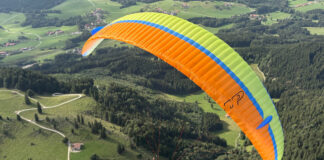
finally had the chance to fly the Action GT, possibly the most
emblematic glider of the new generation of reflex wings and the
latest design from Mike
Campbell-Jones, considered the “father” of
this technology. Its predecessor, the Action, triggered important
changes in the market of paramotor gliders proving the advantages
of speed and stability of this type of profiles applied to paragliders.
Following the success of the Action, and later of the Revolution –Paramania's
all round model for the big public-, many manufacturers have introduced
reflex profiles or more timidly "semi-reflex" models
in their ranges of paragliders for use under power.
The
Action GT is a glider aimed at experienced and competition pilots,
and conceived as a dual model, that is to say, to be flown either
in free flight or with a paramotor - although in this last
modality is where we will find its best virtues.
Construction
and Finishes

The
Action GT shows superb finishes; the glider
is a robust construction with reinforced seams both in the leading
and the trailing edges. Some of the cells are closed and part
of the profiles is made of Dacron, which helps to keep the form
- something specially useful when you go fast (almost always...).
However, it is important to take good care of the leading edge
and fold the Action GT cell by cell.

The GT has load bearing tapes between the line attachment
points where there is higher structural tension. The lines are
distributed in 2 cascades and three lines per riser. The
lines are thick and very strong.

To
launch the Action GT you need to push the risers until the glider
is totally above your head on the vertical, even slightly ahead,
specially if we have the trimmers in a slow-flight mode.
The
risers,
control heart of the GT
The
risers of the GT we tested, named MK2,
are a new design specially developed for Paramania gliders
and also available as an upgrade kit, both for the Action
GT and the Revolution. They are well built and come with
many neat details, like neoprene covers for the trimmers
and the pulleys section, or a detrim handle.
These
risers have 2 positions for the brake handles (with magnets)
depending on the hang point type, high or low.
But
the most interesting feature is the wingtip steering kit,
sort of mini-handles that are kept on
the B risers under a neoprene cover and attached to them
by magnets. These toggles are used to handle the wing when
you fly in "reflex
mode", since the normal brakes get very hard and can
be hardly used. The length of the system can be adjusted
before flying, to suit the pilot's preferences about the
position of his hands when steering the GT (higher or lower).
The
long trimmer system that regulates the reflex section
has now a rigid zone that marks the steps between the takeoff
speed and
the neutral position,
thus helping you to do a precise setting. This means that when you loosen
the trimmer you first notice the step between the takeoff
and Neutral positions, and when you have the trimmer
completely released and start to close it you easily
notice when you reach the neutral position.
|


Magic
or technology? When we totally release the trimmers and activate
the reflex, the Action GT gains auto-stability and it is
possible to hold it only by pulling the speed system lines,
as you can see in the picture
|
| Speeds
I did a few tests to measure speeds and sensations,
and these are my impressions after flying the Action GT size
28 at 600m of altitude asl and with an approximated total
weight of 170 kg (175 kg is the max of the weight range):
Minimum
speed + / - 28 Km/h with trimmers closed and brakes down to
the limit (before stall).
Trimmer positions (no
use of brakes):
Minimum
speed (closed trim): +/- 42Km/h, perfect for slow
flying and/or free flight for turning in thermals.
We keep the best sink rate with the engine off, and have
a good control on the brakes; it is necessary to pilot
actively in turbulences (no reflex).
Takeoff
Speed: +/- 49 km/h. On this setting the glider
comes up well and lift is produced quickly,
the glider is manoeuvrable and a little faster; you have
to pilot actively in turbulence (no reflex).
Neutral:
+/- 51 Km/h. The glider is fast and still steerable
with the brakes. From this point on, the reflex starts
to work on the wing as we release trimmers. If we release
a little, the glider gains noticeable stability but we
still have brake control. If we open more, the brakes will
get harder and less effective as the glider gets more solid
and faster.
100%
open trimmers: 54 Km/h. In this position we'll
only gain a few km/h of speed, but we'll notice that the
brakes get really hard and the glider keeps a great directional
stability. To navigate and keep the course we will have to
use the wingtip steering system, which
is efficient and comfortable to use.
Up
to this position the demand for thrust increases slightly
compared to slow speed and neutral trimming.
Trimmer
100% + 80% speed bar*: +/- 63 Km/h. The Action
GT speeds up and shows its vocation as a racing machine...
You will need a powerful motor to keep up with it at level
flight. The stability is amazing, and to keep the course
we'll only need to correct with the mini-handles.
Trimmer
100% + 100% speed bar*: +68 Km/h. Let's see: If
you are able to push the full length of the speed bar (it's
quite long) and your motor power matches this glider, i.e.
it has a high thrust (+65Kg of thrust for a medium to large
pilot), then you will be able to enjoy a very exclusive
sensation in the world of Paramotoring: to cover big distances
in short time and to travel against the wind with no difficulties
(really, 25k/h of face wind will make you laugh!) While
other pilots cannot think of taking off or leaving the
PG field area, you will be able to log in good flights
and many hours of airtime.
*Warning: you
must never use the speed bar until the trimmers are set to
a position between neutral and full reflex, that is to say,
never when the trimmers are set to minimum or takeoff speed. |

Security
After more than 20 flight hours with different sizes of this paraglider
I can assure that the Action GT is up to its promises, it's an
exceptional glider for PPG: fast, solid and with a very high performance
in balance with a high security level. Nevertheless, this wing
is not for everyone; it requires experience and discernment. Indeed,
when we release the reflex it's possible to fly in conditions otherwise
impossible: navigating in turbulence or high winds, dealing with
strong thermals, crossing rotors... An experienced
pilot will be able to read the conditions and put his own limits in
order to avoid risks, as sometimes we pilots forget that
we fly with just a piece of inflated cloth above our heads...
During the flights I did with the Action GT testing different flight configurations
I never had any collapse. In thermal flying, for example, I noticed that the
wing does not collapse but it may lose pressure causing the wingtip to retract
in accordion style but quickly gaining the inner pressure back. This is an interesting
characteristic because with a normal collapse there's usually a rotation tendency
while in this case the tendency is to fall down some meters but without varying
the course. The worse experienced I had was when I attempted to land next to
El Yelmo Festival's premises, so as not to walk 300m pushing my paratrike. The
wind was catabatic and turbulent but I went all the same; when I was a few meters
from the ground the air was very rough and the glider suffered a few losses
of pressure which I had to compensate as I was flying in no-reflex mode, until
I hit the ground from 2 meters! The consequence: a broken propeller, and a
lesson learnt.
The
Action GT and my experience with paratrike
The
Action GT is a more than interesting choice for Paratrike flying.
The 28 size has a weight range of 85 to 175 kg,
so even with the fuel tank full I am within reasonable margins
of weight. (With the size 23 the excess weight did not help to
add speed and I needed much more thrust). The glider's performance
is good both in climb rate (between 1,75 and 2m/s) and flying
at high speeds. If I step on the speedbar
I can easily exceed 60km/h without losing height,
and I can even climb little by little.
About piloting, the Action GT 28
is dynamic but not nervous; the size 23 is more
acrobatic and you need to be more precise in the handling, specially
if you are high on the weight (as it was in my case, when I tried
it).
To
get the best performance from a glider like this in paratrike
flight it's necessary to have more than enough power, but this
usually has associated a high torque effect. Fortunately,
with the Action GT you hardly notice it! This
was one of the characteristics that made me choose this paraglider
to compete at the Spanish
Nationals 2007 (where I got the 1st place in the paratrike
class) and also for the Worlds
of China in September, since it
offers a great manoeuvrability in both the right
and the left turns, which is crucial for ground tasks like the
Cloverleaf or the Japanese Slalom.
Another
thing I wanted was a bigger wing that would give me better results
in limited-fuel tasks of distance and endurance; well, the GT
has behaved great so far, with performance close to a free flight
glider. I also liked the wingtip steering toggles, with which I can
keep the course with comfort and little effort; but overall I liked
the rock-solid glider that is the Action GT when the trimmers are
released, something that lets me cruise at high speeds even in
rough air. (*I must note that I always keep a safe altitude and
that I've just installed a Cylindricone pneumatic
deployment system for the rescue parachute).
When
I tested the Action GT 28 it took me only one flight to decide
it would be my glider, and my only concern is: will there ever
be a version of 29 or 30m2 with unsheathed lines...?

Conclusions
The
Action GT is a great paraglider for paramotoring; well built,
comfortable to fly, solid, stable and with a top speed difficult
to equal. It is not a glider for beginners or low airtime pilots:
although it is really stable, it also is a very fast and dynamic
glider and things happen quickly when you fly it. An inexperienced
pilot could feel overwhelmed by the use of the trimmers
or doing a landing approach in no-wind conditions. The Action
GT is a glider that will be specially appreciated by the experienced
pilots who like to do long flights and crosses. The only downside
is that, unless your friends fly similar (fast) gliders, you
will get bored of flying in circles waiting for them if you
want to go together... |
|
Materials |
- Outer
sail: Skytex 45 g/m2
|
-
Inner sail: Skytex
36 36 g/m²
|
- Lines: Technora/Aramid
/ 2,3/1,6/1,1/0,6 mm
|
Action
GT - Technical Data
|
Size |
23 |
26 |
28 |
PPG Weight Range |
65 -135 |
75
- 155 |
85-175 |
PG Weight Range |
55
- 80 |
65
- 100 |
75-115 |
Cells |
66
|
Trim Slow speed (km / h) |
30
Km/h
|
Trim Fast speed (km / h) |
50
Km/h |
Max speed (km / h)* |
65
Km/h
|
L / D Glide |
9:1 |
Sink |
min = 1 trim off = 1.3 to 1.8 Max
Speedbar = 3
|
G-Rating |
8+ |
Certification |
EN 926 |
*The Action
GT Manual
is very complete and offers lots of useful
information. You
can download it here.
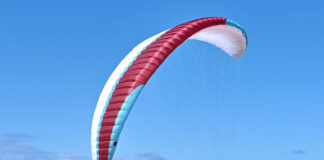
Color
schemes
 |

The
GT has a larger centre cell whose main characteristic is the "nose" that
shows by the leading edge. This feature together with a long central
chord helps give more pressure to the centre of the wing and makes
the glider stiffer despite its high aspect ratio, according to
Paramania. Also, this larger central section improves the directional
stability and reduces induced drag. Besides, the lines from both
sides are linked on the centre to equalize the transference of
weight, which effect is to transfer the pressure on the risers
more symmetrically to the wing, thus improving the inflation behaviour
of the glider.

Inflation
and takeoff
You'll
need a slight adaptation to this type of gliders as they don't come
up as lightly as a free flight wing; we'll have to push the risers
with constant pressure until the canopy is above us, with no fear
of overshoot.

With
wind we can do a reverse inflation with the Paratrike, and then
turn around and take off. It needs some practice and to develop
sensitivity for handling the glider on the ground.
Before launch it is important to check the trimmers and verify that they are
perfectly symmetrical, because small variations in the trimming can cause the
glider to come up unevenly making things more complicated. With some wind the
inflation is quite easy; in no wind we'll have to prepare the glider carefully
and make sure it is symmetrically positioned against the wind and the pilot.
We can set the trimmers to minimum speed for the takeoff but then we'll have
to keep the pressure on the risers a bit longer. Once we have the glider
above us we'll have to do a good run to make it fly; when we have gained
good speed it's best to give a pull on the brakes to help the glider lift
and take off, otherwise the run can be quite long.

Handling
and turns
As I said previously, the long trimmer system clearly defines
the flight personality of the Action GT. From the minimum speed
to a bit over the neutral position, the handling can be very dynamic:
the glider makes good turns and at high speeds; however, for its
high aspect ratio and velocity the margins for manoeuvres are wider
than for free flight gliders.

For thermalling, the best is to set the trimmers to the minimum speed, and we'll
virtually have a free flight glider. It can do flat turns, and if you learn
to take the best of it you'll be surprised to stay high even in light thermic
conditions. If the thermals are strong and turbulent you can even release
some reflex, just enough to keep the handling on the brakes but enjoying
increased stability.
The usable brake travel is nearly 30 cm and the brakes have pressure: if you
spend a while turning in thermals your arms may get a little tired.

Once
the trimmers are off, you handle the glider through the wingtip
line, although if you've chosen this setting there is little to
handle because you're probably cruising from point A to point B,
so you'll only need to do small corrections on the course.

The
speed system of this glider is long and it needs to be well adjusted
in order to obtain top speeds (+65Km/h).
| The+:
Speed & stability
The-:
Takeoff needs continuous pressure on risers and a longer run. |
+Info:
www.flyparamania.com
*Read
other reviews by Theflyingeye
Glider
tested by Daniel Crespo
Daniel is a paraglider and powered-paraglider competition
pilot, Spanish Champion 2007 in PL1 - paratrike.
To know more about
him, visit his blog (in Spanish):
 |