
Index page & overview of Ojovolador.com, brief news, direct links to sections, etc News section: Paragliding & Paramotoring News section: Paragliding & Paramotoring.
Articles, products reviews, reports & interviews by Ojovolador.com
Images, designs and wallpapers
Calendar
Links
About Us
Test and article by Ojovolador.com. Reproduction strictly forbidden without permission. © Ojovolador.com 2007. All rights reserved.

The latest model classified as ‘performance’ in the range of the successful Czech manufacturer Mac Para is a DHV2 glider designed for flying "in peace". With that in mind, designer Peter Rezek put a special effort to obtain a similar stability to the Eden 3’s (DHV1-2), with higher top speed and glide, and with a precise handling. In the design process the company used a software specially developed by them with Karel Vrbesky, the "PG 4 CAD". The Envy is backed by the latest successes of the Mac Para pilots in the highly competitive top level competition circuit, with names like Petra Krausova who has won all the feminine titles of our sport, or the Valic brothers who are not only regularly fighting the first places of international championships but also breaking world records with their Magus (the latest: the distance record with 426km).

The Envy is a very attractive glider, or at least that’s how it looked to me, with an aspect ratio of 5.71, an elliptical planform of soft outline, and a simple but stylish visual design. I "almost" enjoyed more watching the pictures of it every night than flying it... But I say almost because the Envy can offer the performance-pilot a lot of pleasure, thanks to the attributes that define its type of flight: a great glide ratio, high top speed with solidity and stability ideal for long cross country flights and, overall, a very dynamic piloting with a strong personality.
The Envy is a multipurpose glider, suitable both for free flight and for use under power.
Here, we will tell you our impressions after flying the Mac Para Envy during four hours in free flight in the Island of La Palma (Canary, Spain) in varied conditions, and also with paramotor during navigations and ability games at the Tietar valley, playground of Ojovolador.


Construction.
The Envy is well finished and built with cutting-edge materials (see box below), from what is available nowadays. It has good details, like the soft handles with magnetic clips, the differentiated bands with split As to pull big ears, a very robust and quality rucksack...
The inner bag and compression tape are typical of the brand.
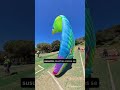
In general the glider is well built, and what I like the most of it is the colours scheme (see picture).

Piloting characteristics
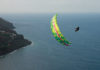
In the air we quickly observe that the Envy has a good performance, it likes to float and it is not difficult to take advantage of the smooth conditions we find in the thermal-dynamic slope of Puerto Naos. The cycles are smooth and the rest of the pilots with whom I share the slope sink around while the Envy soars effortlessly above...

If I keep some tension on the brakes I notice that I can stay up with no further difficulty in handling the Envy. After a while the conditions change, the slope doesn’t work anymore but I start to find very tight ‘bubbles’ of lift which forces me to change the type of piloting to a more aggressive and dynamic one - so that I can turn inside the cores either by making 8 turns or by closing a banked 360 when I can. It takes some effort, the Envy accelerates and in each turn (wingover type) it slightly dives forward, then a surge follows. I must put all my senses in it to find a good control of the glider and stay up.

This character of the glider requires some adaptation and most pilots coming from advanced gliders will not have any problem, but if you’re coming from a DHV1-2 you should take it easy until you get used to the handling of the Envy.

The useable travel of the brakes is around 25-30 cm. The pressure is not high and the response is almost immediate.

If we want to do wingovers we need to be careful and progress gradually since the turns tend to amplify. For this reason is not a glider appropriate for novices to begin in aerobatics.

Performance
The Envy is the DHV2 glider from Mac Para, one of the most successful paraglider manufacturers in the competition scene, winner of the PWC tour 2006 by manufacturers, so it seems clear that performance is one of their goals when designing a glider. The Envy has a sink rate of 1.1 and a glide ratio of 8.7, according to the manufacturer, which seems realistic to me and I’d even add that this can be improved by using a closed harness. The minimum speed is around 24 Km/h; to lower this speed and enter a full stall you need to do a great effort and pull the brakes to almost 80cm.

The Envy flies nicely under power. It has an easy inflation and good speed, and thanks to its performance the fuel consumption is low. If you want a glider for flying both in free flight and with paramotor, the Envy could be a good choice.

Security
I have to say that the Envy felt quite dynamic to me, possibly due to the fact that I flew it at the top of the weight range, but I also must add that during the flights I did -turning powerful thermals- I never had any collapse or the least sign of one. I tried some front and asymmetric collapses later and was surprised by the well-natured reactions of the glider, as the turn tends to decelerate and reopening is almost immediate, it didn’t even complete a 360.

I then saw the DHV tests that confirmed my impressions; the Envy has a very benign certification: Of the 17 in-flight tests for the XL size in the higher half of the weight range there’s not even one in category 2; it has 4 with DHV1 level, and the rest are all 1-2. Which means that I’ve been flying a DHV 1-2 glider! In the other sizes things are slightly different and we can find some results in category 2.

In summary: a lively wing with a very good level of security.


Technical Data from Mac Para

MACPARA ENVY
23
25
27
30

Zoom flat [%]

92
96
100
104,5

Area flat [m 2 ]

23,3
25,37
27,53
30,06

Area projected [m 2 ]

20,87
22,73
24,66
26,93

Span flat [m]

11,54
12,04
12,54
13,1

Aspect ratio flat

5,71
5,71
5,71
5.,71

Root chord [m]

2,58
2,69
2,8
2,93

Cells

56
56
56
56

Weight [kg]

5.8
6
6,3
6,6

Weight range [kg]*

65-80
73-93
85-105
100-130

Min. speed [km/h]

23-25
23-25
23-25
23-25

Max. speed [km/h]

36-38
36-38
36-38
36-38

Top speed [km/h] (accelerator)

50-53
50-53
50-53
50-53

Gliding ratio

8,7
8,7
8,7
8,7

Min. sink rate [m/s]

1,1
1,1
1,1
1,1

Cerification

DHV 2

Materials
  • Top surface: Skytex 9017, Coating E77A and E38A 40 g/m 2
  • Bottom surface: Skytex 9017 Coating E38A 40 g/m 2
  • Main ribs, V tapes: Skytex 9017 Coating E29A 40 g/m 2
  • Minor ribs: Skytex 9017 Coating E38A 40 g/m 2
  • Upper lines: Edelrid Aramid/Kevlar 6843 – 60 kg, - 80 kg
  • Main lines: Aramid/Kevlar 7643-230 kg,-190 kg,-140 kg,-80kg

Color schemes

Envy - that's what your flying mates will feel when they see you with this beauty. Isn't it attractive? And not only that; the Envy has a precise handling, turns easily and has an efficient speed system.

Inflation and take off
The Envy inflates well and immediately gets internal pressure. It does not require any special preparation; just a little pull on the risers will make it raise continuously until it is above your head. It has no tendency to stay behind, on the contrary, if there is some wind we will have to be gentle with the risers and maybe brake a bit so that the glider does not overshoot. Once on the vertical, you can feel the lift and how the glider “wants” to go out and fly. You will have to either use brake input or do a start run depending on if there’s wind or not.


It is really difficult to stall this glider, it requires a lot of brake (around 80 cm) and even then it doesn't come down abruptly, it warns you with losses of pressure.


Weight ranges
For this review we tested the Envy 30, that has a weight range from 100 to 130kg. I was flying it in 122 kg and then I loaded it up to the top of the range to verify that, evidently, with a higher load the wing goes faster and the reactions are more dynamic, which makes me think that the Envy must be sweeter to handle with around 110-115 kg of total weight in flight.


Paramotor:
Mac Para has always taken care of certifying their gliders for use under power and for providing good flying characteristics in this type of flight. The Envy is not the exception and showed a wonderful behaviour when I flew it with paramotor: the easy inflation and good lift make it for an effortless take off; the stability and good speed range are great for fun navigations and its dynamic characteristics are good for ability games near the ground (slaloms, foot-drags, etc.) The Envy is a very good option for the free flight pilot who occasionally flies with paramotor.


Conclusions
A sport intermediate and versatile glider, ideal for combining performance flights with occasional paramotor rides. It has a dynamic style of piloting that balances with a high level of security. Its better quality is the glide at high speed which makes it a good option for competing in the serial class. It is a great glider for intermediate pilots with sensitive hands.


The +: Performance and stability at speed
The -: Sensitive in pitch

+Info: www.macpara.com


*See other interesting articles in our READ! section.

Published: April 17th, 2007

*Test and article done by Ojovolador.com
Reproduction in any media is strictly forbidden, unless specially authorized by Ojovolador.com

If you want to share this information, please pass the Web address (URL) of this page.
© Ojovolador.com 2007

Home | Version 360 | Flying World | Look!| Read! | Xtras | Calendar | Links | Us

All the information and images published in this website are property of Ojovolador.com unless stated otherwise.
Reproduction of any part of these contents (info, graphics & pictures) by other website or media is strictly forbidden,
unless specially authorized by Ojovolador.com.

© OjoVolador 2002 – 2009

All rights reserved. Please respect the rights over intellectual property of this Website.

Ojovolador.com / Theflyingeye.com
email: info@ojovolador.com
Tel.: +34 920387413
Pedro Bernardo (Avila) - SPAIN