
home Version 360Flying WorldNew ParaglidersOjovoladorLOOK! • READ!Xtras
First Contact:
Wings of Change - Nemeton (DHV2-3 / racing)
(see technical data)
by Daniel Crespo + Claudia Riquelme

To test the perfo model from the young Austrian brand Wings of Change was not an easy task. In the first place, the demo glider we had in our hands was a "racing" version with thin lines, not the serial one. Secondly, it was an M size in which our test pilot was more than 10 kilos over the maximum weight and the reserve pilot, about 10 kilos below the minimum...
Considering the scenario, we decided to do as much as we could to form an idea of the characteristics of this model (quite unknown in Spain) in spite of the difficulties. Thus, we carried out a large number of inflations and flights, some overweighed, some low weighted and some with ballast, and we finally asked the help of a medium-sized friend to fly the Nemeton and give us his impressions (thank you, Nacho!). The following is, more than a test, a flying investigation.

Photos: Ojovolador

At first sight
To contextualize things, we can say that Wings of Change is an Austrian make related to an almost emblematic personality of Acro flying, Markus Grundhammer or "Akrominator", partner of Mike Küng in exhibitions and aerial feats, and test pilot for some brands –like Edel, from which he obtained the inspiration for the name of his company (an old Edel slogan). The factory was born about 3 years ago with a tandem model and a perfo/acro one, always looking for the maximum dynamism and performance in their gliders, as the leader of the company likes it. At the moment, they have 6 paragliders in their range and the Nemeton (serial) has been certified DHV 2-3 in the M size (the rest still pending). Design is in the hands of Michael Nesler, an experienced creator of paragliders for various houses, with the work of a team of pilots who share the taste for the most radical flight.

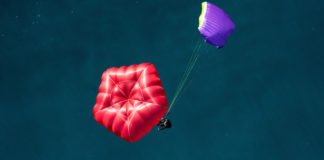
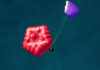
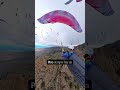
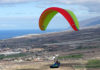
The first thing that calls our attention from the Nemeton is the complicated design of the outer sail, a figure that reminds of a mythological bird but which in fact represents an "alien", and it is also the logo of the company (soon to be introduced in all their gliders’ color designs). The illustration is sewn in the fabric and requires a great seam work: 164 pieces of fabric (!) that speak well of the construction capacity of the brand. It is available in various color schemes, all of which attract immediate attention at any flying site.

The construction of the glider seems traditional, with open cells, reinforcement tapes, and simple finishes (leading edge not reinforced), but at the factory explain that their design of the leading edge is "unique" and has been specially developed to obtain all the advantages of closed cells (stability when accelerating, internal pressure and a "flat" polar curve at high speeds) without their problems, like a technical inflation or a more violent reopening after collapses. "WOC leading edge” has been called. Maybe thanks to this, the serial Nemeton passed the German certification with only one 2-3 qualification, when accelerated, whereas in the rest of the tests it has a passive security level of DHV2.

For the design they use sophisticated software, in addition to intensive flight testing. The Nemeton reminds us of some competition models from Edel, maybe because of the Nesler "touch" in the design. It is made in Porcher Marine NCV 9017 fabric with E77 coating, resistant to water, abrasion, and UV rays. The lines are Edelrid dyneema for superior cascades and aramid for the inferior ones. The "racing" version comes with unsheathed thin lines. All the gliders are produced in Sri Lanka (Airsports Lanka) and checked at the factory premises in Austria.


Open leading edge specially designed for the Nemeton ("WOC leading edge") offers the benefits of closed cells without their problems, according to the factory.


In action
The first flight with the 'Nemeton racing' was done by Daniel with more than 10 kg over the top of the weight range, and he reached amazing speeds, but the sink rate also worsened proportionally. It was at least useful to verify the acrobatic qualities of the glider.

Inflation is very easy thanks to the open cells and the responsive handling of the glider. Even when launching outside the certified weight range (way below the minimum) we did not find any problem to inflate the glider in very light wind. It raises compact and it is only necessary to apply small corrections once above the head to be in the air with a touch on the brakes.


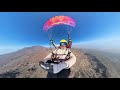
Once in the air we discover in the Nemeton a fast machine. At trim speed the lines (thin) whistle when cutting the air and we reach almost 40 k/h without problems (at the higher half of the weight range). If we step on the speedbar we can get some extra +15k/h and reach 55k/h or more, although the sink rate also increases. In fact, we find the best sink rate when we apply a little brake, about 10 cm.

The feeling of the glider is of a good internal pressure, and it is easy to control even in some turbulence. It is a very responsive glider that reacts well and quickly to weighshift and braking, which makes easy to obtain flat turns, or spiral down at full speed combining brakes and weight. The answer comes agile and fast, with great energy retention, specially suited for acrobatic maneuvers. The brakes have pressure and are of rather short travel, which make the Nemeton a glider for experienced pilots, as the certification indicates. The Akrominator himself took care of adjusting the brakes as he likes them.

Performance wise, it’s competitive in its category and appears as a versatile glider, in which you can get maximum pleasure doing Acro, or in competition covering kilometers and hurrying the last glide to goal.


Paramotor
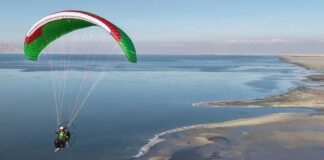
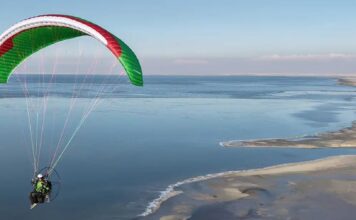
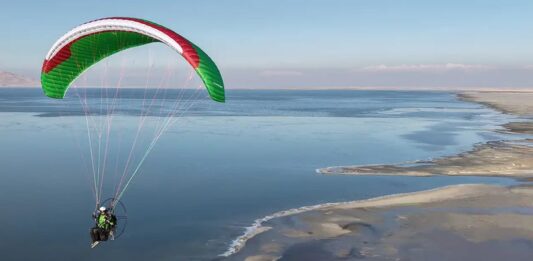
We had the chance to test the Nemeton with paramotor, a type of flight in which its qualities of easy inflation and short brake travel made it very pleasant to fly, although the extra weight accentuated its dynamic characteristics. We had banked turns, high reserves of energy and some whip of the tips caused by sudden changes in the internal pressure of the glider. Summarizing, it is not a glider to begin in powered paragliding but if you own a Nemeton, have the required skills and choose the conditions right, you can take advantage of its speed and agility.


.

For whom
An experienced pilot, who enjoys dynamic flight, will surely find in the Nemeton a good partner. Acro lovers will not find flaws in it, unless they are beginning -in which case they’d be better choosing a glider with less aspect ratio.

The glider comes with inner bag, a huge rucksack in which you can even carry your girlfriend if it’s necessary, and the user’s manual (in English and German).


  • The+: The dynamic piloting and good speed
  • The-: Somewhat basic finishes (at least in the racing version)

*Demo glider: Nemeton "Racing" (thin lines) uncertified, M size.

Pilots: Daniel Crespo; Claudia Riquelme; Ignacio Montoro.

Instrument: Brauniguer Compeo.

More info: www.wings-of-change.at

* Thanks to Markus Grundhammer from Wings of Change for sending us the demo glider for this ‘contact making’.

home Version 360Flying WorldNew ParaglidersOjovoladorLOOK! • READ!Xtras

Si© Ojovolador 2004
... . Ojovolador.com
email: info@ojovolador.com
Ph.: +34 920378503
Lanzahita (Avila) - SPAIN