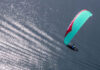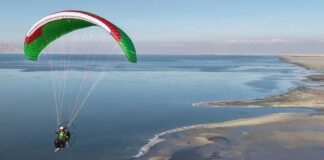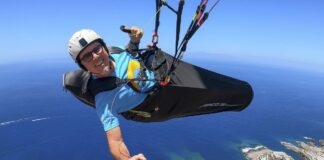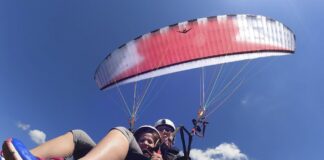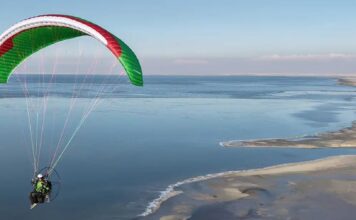
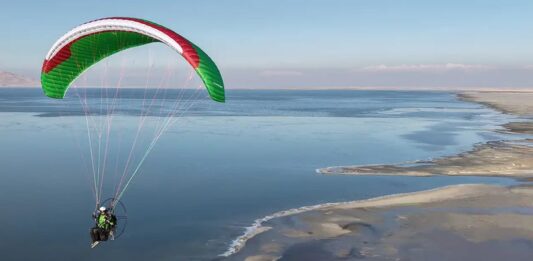

Finally I could test the Dudek Nucleon, one of the star gliders of the 2009 season, current world champion in both categories of paramotor: foot launched, in the hands of Michel Carnet, and Paratrike with Tomasz Kudaszewicz. The Nucleon has also won a few national championships, including the Spanish one in Paratrike where our friend Alfonso Redondo took the gold in 2009.
The odd thing is that the Nucleon was launched as an intermediate glider suitable for the general public; its plus points are easy inflation, wide range of speeds and high stability thanks to the reflex profile, and a very interesting performance. A set of qualities that is easy to benefit from even if you are not a "super pilot".
Take off
This glider has uncomplicated and even takeoff. Thanks to the relatively large cell openings and with the trimmers on "neutral" position, the canopy takes its shape quickly, inflating smoothly and without violence. The Nucleon only requests to maintain the speed during the take-off run and to keep the pressure on the risers until the glider is flying totally above the head.
If we do not touch the brakes the lift arrives at 41 km/h, then we notice how we penetrate the air upwards with speed, aplomb and a defined path that does not require adjustments to keep the course.
Speeds
The range of speeds and the performance are the strongest points of the Nucleon. With the trimmer completely closed and slowing down the wing to the maximum it is very difficult to reach less than 28 - 30 km/h. On neutral trimmer position we keep an interesting 42 km/h. At this speed the Nucleon barely demands gas and navigates very well in calm air, but if we have a slight face wind or a bit of turbulence then releasing a couple of inches of trimmers pays off; the increase in consumption is minimal but we manage to reach 44 km/h with a solid wing. If we have more than 10 km/h face wind the best combination is releasing some 3-4 cm of reflex and using the speed bar, this way the glider has an excellent compromise between performance, speed and stability. If we have a strong wind of more than 15 km/h, certainly the thing is to fully release the trimmer, which would let us reach 50 km/h, and help with the speed bar. With this combination and a high load we can speed the Nucleon up to 64 km/h. However, in this configuration the Nucleon needs a powerful engine to make up for the sink rate.
Three controls
This glider has three systems to control the direction and turn: first there are the conventional brakes that act on the trailing edge. They work best when we use the trimmers in no reflex or neutral mode; although at Dudek have made an effort in the design so that they can also be used with the reflex on. The Nucleon responds well and has an efficient turn, although lacks a bit of energy for more closed turns.
Next we have the Alternative Control or ALC, which acts braking only the tip of the wing and it is intended to increase maneuverability and allow for more closed turns when we fly in total reflex mode. The ALC is operated with a small red ball that can be moved with two fingers, and every pilot can adjust these mini-controls to apply a certain amount of ALC when used together with the normal brakes. The mini-control lets you do turns even at top speed without affecting the reflex profile, although some training is needed to achieve good closed turns.
Finally, we have the TEA or Torque Effect Adjuster, whose purpose is to counteract the effect of the engine that makes the paraglider turn in an opposite direction to the rotation of the propeller. The TEA, which is placed on one of the two risers (you must order it according to the paramotor you have), acts on the length of some of the wingtip lines and can be fastened with a magnetic trimmer to “brake” the side and navigate straight.
During the last Paramotor Worlds 2009 in Nove Mesto, in the slalom tasks like "the eight" or "the clover leaf", the best pilots flying Nucleons used a combination of neutral trimmer and conventional handling with the brakes and ALC. This way they could make very sharp and banked turns.
All this array of risers, trimmers, handles, controls, balls and speed system is a little confusing at first, and so it is best to integrate their characteristics and potential step by step to our type of flying. At the end you will find that they are worth the effort and you will appreciate the comfort in flight, especially in long flights and raids.
What size?
Dudek offers 6 sizes of glider ranging from a 23m2 (not certified) with a weight range of 65 to 85 kg, to four more typical sizes, 25, 27, 29 and 31m, to finally close with an extra large Nucleon of 34m2 that can be loaded up to 175 kg. A very wide range to choose the one that best suits your flying style. Certainly this wide offer will give more than one headache to those who have to make the choice of size.
I flew the Nucleon 31, whose recommended range by the manufacturer is 120 to 145 kg, loaded with 162 kg. I used a paratrike Airfer C1 fitted with a VR200 engine. With this combination I did my measurements and, in general, the high load a bit overweight was perfect for the paratrike. During the inflation I could bring the canopy over the head with total ease, the take-off was fairly short and I had power to spare for all possible combinations of trimmer and speed bar. My maximum climb rate was 2.2 m/sec.
I also flew this glider with the Parabuggy Quattro, loaded up to about 180 kg. With this Paratrike I did not install the speed system so I did not use it, but I noticed that I gained about 5-6 km/h in the entire range of the trimmer; of course, the take-off run was longer, but once in the air the performance was quite good, and above all I noticed that the energy in turns increased significantly. I liked it.
I think that the ranges indicated by the manufacturer are ideal for footlaunch or Paratrikes with not too powerful engines, or for competition because there you need a good compromise between short take-off run and good performance in thermal flight. But if we care nothing about competition and have a lot of power on the back we shall dare to fly smaller sizes: we lose some performance but gain a lot in speed and agility.
Construction and guarantee
At Dudek have decided to bet high for quality and therefore the Nucleon, besides using proven materials like Skytex cloth or technora lines, comes with a myriad of details and acronyms: Large strong pulleys; TCT or triple comfort control handles that can easily pass from rigid to semi-rigid to soft; magnetic clips; and wingtip openings to clean the canopy. The A risers are divided to make the inflation easier and for big ears; the trimmers are extra long and have an indicator with cm., which makes it easy to know the exact amount of trimmer you open.
The internal construction of the glider is also complex and full of details that we might not appreciate at first sight (such as internal v ribs, load tapes, optimized intercellar openings, closed cells structure, etc.) but whose aim is to provide clean profiles and, therefore, a notable performance, more durability and a smooth and wrinkle-free general look of the sail.
To top it all, the Dudek warranty for three years covers any material failure or manufacturing defects.
Dudek Nucleon - Siza
23
25
27
29
31
34
Certification
-
EN C
EN C
EN C
EN C
pending
Number of cells
62
Flat Area [m2]
23.00
25.00
27.00
29.00
31.00
34.00
Projected area [m2]
19.58
21.28
22.99
24.69
26.39
28.95
Span flat [m]
11.14
11.62
12.07
12.51
12.94
13.55
Span projected [m]
8.93
9.31
9.68
10.03
10.37
10.86
Aspect ratio (flat)
5.40
Aspect ratio (projected)
4.07
Sink rate [m/s]
min = 1.1 ; trim = 1.2-2.0 ; max = 3.0
Speed [km/h]
min = 23 ; trim = 37-50 ; max = 62
Max cord [cm]
245.69
256.15
266.20
275.88
285.23
298.72
Minimum cord [cm]
49.14
51.23
53.24
55.18
57.05
59.74
Distance pilot to wing [cm]
713.25
743.62
772.79
800.90
828.05
867.20
Total lines lenght [m]
375.67
391.67
407.03
421.84
436.14
456.76
Weight range * [kg]
65-80
75-95
90-110
100-130
120-145
135-175
Weight of the wing [kg]
-
6.6
6.9
7.3
7.8
-
Lines
Technora 1.2 & 1.3 & 1.5 & 1.8 & 2.3
Fabric
SkyTex Evolution 40 g/m2
SkyTex Classic 40 g/m2
SkyTex Hard 40 g/m2
SR Scrim, SR Laminate 180 g/m2
XC airship
When it came to navigations I found several aspects of the Nucleon that I liked, for example: it is easy to adjust the glider to fly straight and it is comfortable to fly as it does not tend to oscillate. Once we decide the direction, we tune the engine revolutions and then with a small adjustment of the TEA we compensate the torque effect. The TEA is a kind of a trimmer that pulls the line of the wingtip opposite to the torque effect.
You can forget about constant corrections or unwanted movements, as even in bumpy air the Nucleon seems to glide on a rail. We can also use the mini controls (ALC) that allow you to turn even when you navigate in 100% reflex mode.
The Nucleon certainly has a vocation for cross country flight; it is fast, reaching 64 km/h (depending on the load of the wing), very solid when you release the reflex and especially easy to fly it straight thanks to its control assistances, the ALC and the TEA.
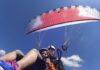
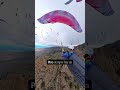
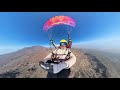
Although it prefers to fly straight and fast, at Dudek have dedicated a fair amount of work -with the help of Michel Carnet- to develop the alternative controls: two small balls that let you apply brake only on the wingtip to produce close turns. On the picture you can see how the tip seems to be near the stall point.
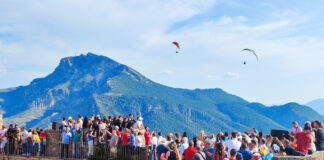
During the last Worlds in the Czech Republic we could observe many Nucleons of different color combinations, as allegory of the national colors of the competitors.
For whom
Have you ever dreamt of having Contador’s bike or driving Fernando Alonso’s F1 car in your neighborhood? Perhaps in these sports the chances of having a world champion gear is remote or, better said, nonexistent; but, luckily for the fans of paramotor flight, in our activity it is real and Dudek also makes it easy because the Nucleon is not a glider for a few "top guns". In fact this is a rather easy glider to fly; another thing is that you can actually get the maximum performance from it. In particular, and in our view, this glider is not suitable for pilots just coming out of the school, but it might well be your second glider. Henceforth, a very broad scope of pilots will find it performing and attractive, especially those who enjoy long expeditions, navigations and, of course, competing. The hardest aspect of the Nucleon is to get used to the mix of "brake-speedbar-ball". Apart from that, it offers excellent performance for paramotor or paratrike flying, and you can also fly it overloaded to get extended speed performance.
If you are a radical pilot and you like steep turns and immediate response, then perhaps this glider will not fully satisfy you.
Conclusion
The evolution of the sport produces gems every now and then, and the Nucleon is one of them. Dudek was behind the European and World Championships for quite some years, first with the popular Reaction and later with the stylized and superfast Plasma. Their new intermediate glider, supposedly of less performance, turned out to be the most efficient competition machine and the one that took the gold, twice!
In short, the Nucleon is and may continue to be for a couple of seasons, one of the reference wings in the intermediate sport class. A great choice if you like its characteristics.
The +:easy inflation; fast and robust.
The -: The risers are complex, with multiple controls that need getting used to.
Color schemes
Flight tests performed by Daniel Crespo using the paratrikes Airfer C1 and Parabuggy
Quattro A1
Data logger: Brauniguer Compeo+ +info: elpana.net
All
the information and images published in this website are property of Ojovolador.com
unless stated otherwise.
Reproduction of any part of these contents (info, graphics & pictures) by
other website or media is strictly forbidden,
unless specially authorized by Ojovolador.com.