
Home | Version 360 | Flying World | New Paragliders | Look!| Read! | Xtras | Calendar | Links | About Us
UP SUMMIT 2 (Dhv 2)
(See technical data)
by Daniel Crespo V. / Ojovolador

This is a paraglider that combines all the characteristics that have made UP famous: elegant and sporty appearance, an active and direct handling, and interesting construction details like the leading edge with wider cell openings on the centre that taper off to the tips, maintaining good characteristics of inflation and internal pressure. The factory based its construction on their competition models, with a different trimming. The new design of the glider aimed at obtaining maximum stability at speed, and the line attachments go on every third cell for low drag (a total of 152 lines) keeping the tension on the outer sail thanks to the internal V-ribs system.

Photos: © Ojovolador

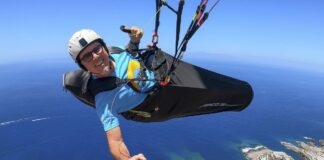
When we received this glider we liked the combination of colors, orange and gray with the usual UP black stripe on the center, a sporty and at the same time smart appearance. Luckily, on the following day we could make the first flight with it from the west takeoff of Pedro Bernardo (central Spain), our local site. The wind conditions were a bit strong, with disorganized and difficult thermals.

As we did not know the characteristics of the Summit2 we had some doubts about how it would be to launch with it, but with wind gusts of 30 of k/h we found no problem: even in sometimes crossed wind and turbulence, the glider inflated well and easy by pulling the risers softly and controlling the canopy with the brake - as its DHV2 certification states.

A balanced glider
The first sensations we got from the Summit2 were of a very solid glider with a lot of internal pressure. It has an uncomplicated appearance that doesn’t look or feel aggressive. UP’s internal structure “Honeycomb-V-tape” system contributes to keep a high pressure inside the canopy and distribute the load efficiently among the cells, which at a practical level is translated into smaller losses of pressure caused by the air movements. In this flight I could also verify the easy use of the speed system and its effectiveness. It is somewhat hard to pull but you can use it with enough security even in strong wind or with some turbulence. In our flight some pilots remained grounded on the take-off while I could soar happily with the Summit2…

Regarding handling, in this first flight with inconsistent thermals I had to adapt to the particular piloting style of the glider, with a short brake travel, precise and with a feel of high pressure. In order to climb in these difficult lifts I had to try different speeds and ways to make the turns until I understood it and could stay in a spiral climbing at the best ascent rate. The process required some getting use to the use of brake and weightshift, especially because the day was very windy, but in return it gave me back good sensations and a good time of active paragliding.

Speed and dynamic control
Some days later, during a PG meet at El Bierzo (Leon, Spain) we could do 3-4 flight hours in good conditions, with thermals up to +4, small cumulus, base at 2800m and light wind. Again we confirmed the easy takeoff characteristics of the Summit2, although you need to guide the risers up until the canopy is above your head, otherwise the glider shows a slight tendency to stay back. But once it’s above you the Summit2 glides comfortably in the air. It has a trim speed at 37-38km/h that lets you enter comfortably in the thermals. The glider gives back enough information, and if you have a harness with low hangpoint it can be a real joy to fly it.
In summary, it has good thermaling qualities and it’s easy to move with it in the lift to find the best core: it shows no tendency to lose it or to return to straight flight, especially if banked.

Comfortable transitions
The Summit2 is docile in transitions, both at trim speed and pulling the speed bar. It is easy to keep a speed between 45 and 50 k/h. It gave a max speed (pulleys touching) of 52 k/h being on the higher half of the weight range. We had the chance to test the minimum speed in the slope of San Agustin (Leon), where a coming front gave us a floaty and dynamic soaring flight with which we had a lot of fun wagging and wing-overing the Summit 2, testing the behavior of the glider in these maneuvers.
It is possible to take the Summit2 to almost 22k/h but you need to put a good effort on the brakes because they get very hard. Strong and sensitive pilots will notice on each wing the warnings of the glider approaching its minimum speed, which will make difficult to stall it by mistake.


Wingovers, collapses and big ears

In the wingovers we verified that UP is again at its best: They have obtained a glider that has a good retention of energy and allows to easily round up the turns by using weightshift and brakes. In only two inversions of turn we can be passing over the axis of the glider. As for spirals, in half a turn we can be sinking quite fast (between -15 and -16m/s) and we can exit by breaking the energy up in a couple of turns or in a single one but with a big, not-violent surge. In fact, when practicing ‘dolphins’ I verified that the glider is very pitch stable.

To make big ears we have to pull the outer A-lines as it has no split As. The risers are classic, wide and robust, of confidence--inspiring aspect. The ears with one line are small, lowering the sink rate slightly. In straight flight they stay in, but at the first weightshift they start to open by themselves.


To finish this set of sensations with the Summit2 I gave a strong pull to one A riser that caused a collapse of 50% or more, but which I could stabilize with my weight and even stay ridge-soaring. Reopening was automatic just by releasing the riser.


Paramotoring

The qualities of the Summit2 fit very well with powered flight.
The takeoff is comfortable, the glider raises immediately and its internal ventilation system helps it to gain pressure very quickly to offer lift.
It is a docile paraglider but with a sporty spirit, that has the grace of balance and smoothness, interesting values for paramotoring.
With it we can perfectly draw up the turns or our landing approach. Its handling requires some strength but it is compensated by the extra security offered by the motor thrust.
The Summit2 flies well enough under power to become a valid option even for advanced PPG pilots that use it exclusively for that purpose.


Conclusion
This intermediate UP glider can be considered as a perfect mid-range DHV 2; its security level is high but this does not affect its dynamic sensations. As for performance, it does not stay behind within its class offering good climbing qualities for thermal flight and good glide speed.
The Summit2 will surely be a source of good sensations for its owner.
The pilots with like for Acro who want some 'spice' will be able to take the most of its handling and will be rewarded with strong emotions.
Experienced pilots who appreciate precise handling and pilot control will find in the Summit2 a smooth and safe glider offering everything to have a great time in the air.
Pilots who have already spent enough airtime in a glider of lower certification (+100h) can also change to the Summit2 and start to enjoy one stylish paraglider.


  • The +
    Precise handling and good feeling in the air.
  • The -
    Inflation requires taking the risers up until the canopy is above the pilot.

See technical data for Summit 2

*Test flights performed on a Summit 2 size L, with a total load aprox. of 118 kg.

Pilot: Daniel Crespo Valdéz

Instrument: Brauniguer Compeo.

More info: www.up-europe.com

*Our thanks to UP Europe for sending us the demo glider for this review.

Home | Version 360 | Flying World | New Paragliders | Look!| Read! | Xtras | Calendar | Links | About Us
Si
© Ojovolador 2004

email: info@ojovolador.com
Tel: +34 920378503
Lanzahita (Avila) - SPAIN