
| 
Inflation
With light wind the Torck 2 preforms and rises all in one move; its 61 cell openings (of a total of 71) allow the air to shape the sail in a "blinking" and once the profiles are formed the wing surges to the vertical symmetrically, demanding that we hold it so that it doesn’t shoot forward. This is just a gesture as the Torck can be handled with little inputs.
With the glider over the head we notice that it is not difficult to take control of the wing, it stays obediently above, without asymmetric or yaw movements, you just have to control the pitch a little using only a few centimeters of brake travel.
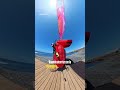
After a couple of steps and once in the air, I feel the racing spirit of the Torck 2; the glider cuts in the air and moves quickly.

Racing spirit
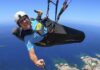
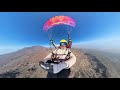
The second and final test-flight I could do with the Torck 2 was a beautiful solo cross of 70 km, taking off at 14:30 with a light wind from the East, which let me fly towards Plasencia, going over Candeleda and the county of La Vera in Extremadura, after launching from my local site, Pedro Bernardo (Gredos range, Avila, central Spain). In this flight I "explored" the sportive qualities of this paraglider.
It was July 25, a very hot day of blue thermals that involved some difficulty at first but improving as the day progressed. Inflation and takeoff involved no difficulty; however, the first few minutes in flight were complicated because I launched at the end of a thermal cycle and I had to scratch zeros until slowly managed to climb the east face of the ridge. First by doing eights and then full 360 turns, when I climbed over the top I drifted a little to the back where the sun was heating well. There I found a good thermal and could climbed to 2,400 meters by doing wide turns to take advantage of the confluence of at least two thermals,.
The Torck 2 climbs well, has a very precise turn and flies with speed, which requires some adaptation for pilots coming from lower class EN C wings.

Turbulence
The Torck 2 has a lot of internal pressure and turbulence feels somewhat brusque, fortunately collapses do not come easily though. After making my first transition to the Abantera peak, I came just over the ridge and could not avoid the thought that the area has a high record of reserve deployments. This thought upset me a bit as, suddenly, I went into an area of strong turbulence where I had to exercise active piloting, using weight shift and doing short but constant corrections with the brake. At one point I got a couple of strong bumps, it was time to see a good collapse coming in and I got ready for it, but what I got were three consecutive closure of wingtips, left -right - left , which remained nothing. From there on the flight became easy-going, I gained a lot of confidence in the wing and even at one point, by the last part of the flight, I released the brakes for a long while to call my retrieve with the cell phone...

Perfomance
The Torck2 has enough qualities to help a good pilot get a place on a podium: Its glide ratio is around 10.5, a little less if you fly it with a normal harness as it was my case; top speed reaches 60 Km/h and, above all, it offers a good combination of closed turn and low sink rate. |

Design and construction
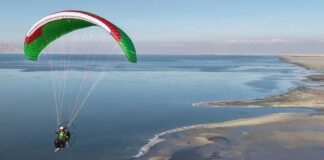
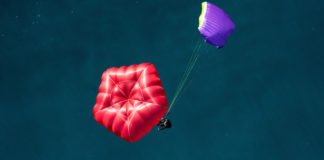
The Torck 2 has an aspect ratio of 7 points (4.7 projected), and three-line concept; three main lines per riser (3) that divide in two levels which, in turn, are divided into two more lines. It is a reduced line plan and, nevertheless, the glider keeps a well-defined shape thanks to its diagonals and internal reinforcements. All of these details as well as a much defined brake line can be seen from below. A great concept and construction work. I tried Driu (the Spanish dealer)’s glider that already had about 50 hours and, in general, the state of the glider was excellent. The risers are well worked out and the speed system is quite effective, although somewhat hard. My only critic would go to the material of the risers that had some loose threads (which I burned out with a lighter). |
The +: direct handling and turns.
The -: loose threads on risers. |
+
Info: solparagliders.com.br
|
18 years of experience and nearly 40 gliders produced have granted the Brazilian manufacturer Sol a deserved place among the leading brands in the paragliding world, thanks to their efforts to build wings of good quality and performance. Their own factory, located in the South of Brazil, is DHV certified for the production process and Sol offer warranty of 3 years or 300 hours of flight for all their gliders.
The second generation of their high-performance model incorporates technologies and materials used in their competition (open class) wing TR2 and the acro glider Supersonic; it is a 3-line design with lines reduced to the maximum for an optimal weight-performance ratio.

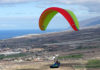
I did two flights with it, the first one in very light conditions: smooth thermal-soaring in the evening. I noticed how I passed through the rising air not being able to take advantage of the best climbing area, which was very tight. It took me 15 minutes to "trim" my brain and find the optimal speed of minimum sink rate; I had to pull the brakes well over what I thought at first, a point of braking that I found somewhat physical but which was finally efficient to keep me in the air. The rest of the flight I went over the cliffs on Pedro Bernardo trying to go close to the West takeoff so my mate could take pictures of me for this article.
I flew for an hour and a half, and every minute that passed I felt more integrated with the glider and its handling.

Full speed bar
I continued the flight to Arenas de San Pedro and from there I could see a “street of mist” on the Valley, to where I headed. From this point on, the flight was a stroll; I did a couple of long transitions stepping on the speed bar, sometimes at half the travel and other times at full bar. The speed system is short and somewhat hard, allowing a maximum speed of around 60 Km/h. At this speed the sink rate is not bad and the glider keeps a significant level of solidness, even though I did not use the bar much in this flight because I had some tailwind and there was not much sink on the way. There was a little East wind but in general the thermals rose quite straight.
The Torck 2 definitely turns well and has a very short brake travel; the first cm have no effect but as soon as we notice the pressure we just need a few centimeters of brake to put the wing to spin. The brake gets hard though, and the feel of it is far from soft.
I flew across the county of La Vera quite comfortably and by the end of it I remembered that I had to be home early, so although the day still looked well I decided to try a final glide as there were good landing options on sight and my retrieve was close behind me. I set myself a rather ambitious goal that, honestly, I did not think I’d reach - but the fact is that I got there well, even with some height to spare, so when I saw a small harrier climbing at barely 50m over a hill I went straight there thinking that if I found some lift I would continue the flight; such good conditions don’t happen every day!
I was doing very close turns near the ground and just below me there was a helipad. It seemed that I could climb back up and continue my flight with the harrier but then I began to hear shouts… I looked down and saw 6 or 8 people waving hands and shouting at me from the heliport. Damn it! It seems that the helicopter has to take off, I thought, so went back to my original plan and quickly went to land on a clear spot. The thing is, after doing a couple of turns and landing, I heard them clapping from the heliport… apparently the helicopter was not going to take off and they were just shouting because they were amazed with the paraglider!

In any case, it was a very complete and exciting flight; I could test this second edition of the Torck quite well and verify that at Sol are really taking their business seriously, with a glider of outstanding quality level.

For whom:
Without a doubt the Torck 2 is an advanced glider aimed at experienced pilots who prefer a direct feeling. The Torck 2 is neither a dampened or simple glider; it asks for corrections and precise steering so advanced pilots, competitors and cross country enthusiasts, are the ones who will best enjoy its advantages. |
Test done by Daniel Crespo,
Daniel is a long time paraglider & paramotor pilot and competitor.
Check out his blog (Spanish):

|