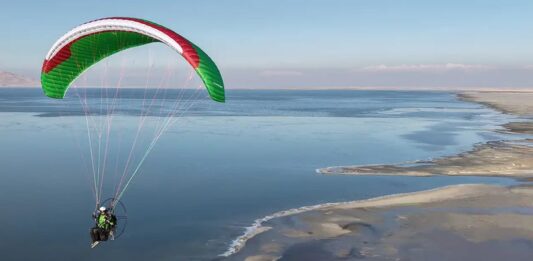

The Cayenne, unlike its rival, has a short brake, even a little hard, although equally precise.


It is almost impossible to stall the glider by mistake in the Cayenne.


Inflation is very easy and the glider shows no tendency to overshoot or fall to one side. The split A risers help to a smooth inflation when the wind is strong.


The Cayenne needs to fly with speed, and then you will enjoy the best of its dynamic flight and spicy response.

It has an acceptable level of damping in the axes of yaw and pitching, so it can tolerate some inaccuracies from the pilot, but without sacrifising dynamism in the execution of manoeuvres.

The Cayenne will provide a high level of satisfaction to its owners, specially in construction and quality details.


It is a good machine to evolve in thermals and allows a flat turn.


It is very easy to pull the ears in with both gliders, thanks to the split As.


More info: www.skywalk.info

home / Versión360º / Ojovolador / Services / look / Read / Xtras

Last generation sport / intermediate gliders, face to face:

While during 2002 the rising category was the DHV 1-2 (basic-intermediate gliders), this season the focus has shifted to the DHV 2s. There seems to be a special effort from some of the manufacturers towards a segment that should be, by definition, the most versatile and maybe even the most commercial: the intermediate gliders.

I was very lucky to test these two “truly” intermediate gliders almost simultaneously and in diverse conditions. These are paragliders with no overstated pretensions about performance –and maybe for the same reason, very pleasant to pilot- that offer a great feeling of active security. Gliders that could be used by most pilots with enough experience, with no compromise. Fun, all-round gliders.
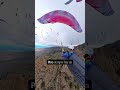
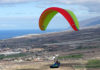
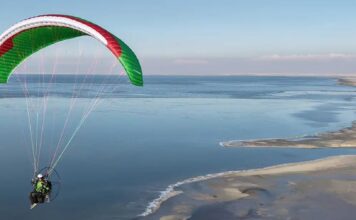
The Cayenne and the Vulcan also share another interesting characteristic, which is a cared and original visual design. I can say, with no exaggeration, that these are two very attractive gliders: the Vulcan looks sport and suggestive in its tribal freshness, while the Cayenne has an innovative “techno” look. Honestly, it was about time to see something new in the appearance design of the paragliders, as it seems that most manufacturers don’t dare to innovate and prefer to stick to the “classic”, by adding little renewals season after season (which makes sometimes hard to tell one glider from another in the air).

On the ground
I believe that the feeling you get by ground-handling a glider tells a lot about its in-flight behaviour. We practised inflations with no wind, and they were very easy both with the Vulcan and the Cayenne, no special tricks required, just the usual pull on the risers and you quickly had the canopy over your head, with no tendency to overshoot or fall to one side. I also tried it in a deliberately wrong way, being not centred with the glider and pulling abruptly, but the result was close to a beginners glider: self-correction and a clear tendency to go towards the right position over your head.
A reverse inflation is a game; both gliders have split A risers to pull big ears, which are also useful to make the glider come up gradually according to the wind conditions. If it is strong, you can just pull the central As and the canopy rises smoothly, being also easier to control.
In the Vulcan, the sense on the risers during inflation is progressive and we can graduate almost centimetre by centimetre the way it climbs over our heads.
In the Cayenne I noticed a point where the canopy just wants to go straight up.
With slightly stronger winds, from 25 to 30 k/h, it becomes a bit hard to keep the gliders grounded. They want to fly and they even inflate by themselves if you don’t use some strength to keep them down, something a little more noticeable in the Vulcan. This forces the pilot to be attentive because the canopy can get some inertia while climbing to the top and it’ll need to be retained so as not to overshoot you and collapse. In this sense, the easiness of the inflation in light wind can be against us in stronger gusts.

Brake feeling
The Vulcan has a long, smooth and progressive handling, which makes very easy to dose the amount of brake to apply. With the body and about 20 cm of brake we reach nearly all the range of piloting. It is possible to take the glider very restrained and it still stays flying. The handling is one of the most remarkable points of the Vulcan (or maybe the most), a real pleasure.
The Cayenne is also easy to understand but, unlike its rival, the brake is short and even a little hard, although it is very precise and easy to control. It asks you to let it fly with speed, and if you do it you will enjoy the best of its dynamic flight and spicy response; this way, the changes of direction and 360 turns come in very effortless. But if you try to take it slowly you will find a sluggish answer. Therefore, you’ll be better flying the Cayenne with slight touches on the brakes and using weightshift as much as possible.
Once we get used to the handling of each of these two beauties, we can confirm that a DHV2 glider can be safe and, at the same time, offer us all the sensations that seemed reserved to more advanced gliders.

Manoeuvres
The Cayenne and the Vulcan have an acceptable level of damping in their axes of yaw and pitching, enough to prevent that small inaccuracies in the piloting could lead to overcontrol, but without restraining a more experienced pilot to freely execute dynamic manoeuvres like wingovers, dolphins or even Sats. They are prone to the fun!
Wingovers are delightful, if we swing well we will be able to amplify the trajectory and pass higher and higher above the canopy; but if you are not fine enough the glider becomes lazy and you lose energy. Both are suitable to begin with aerobatics, although they are not gliders designed for it. In the Vulcan we can feel the "inheritance" and the taste by Acro left by its predecessor, the Octane.
With the split A risers it is easy to pull big ears both in the Vulcan and in the Cayenne: you need to keep the risers in your hands and hold them tight, because they tend to reopen. It is also possible to do big big-ears, but then it is necessary to grab lines from the central A, and only a small piece of the canopy will remain open.

Speed
The Cayenne and the Vulcan gave about the same measure of minimum speed, 22 k/h, but whereas in the Cayenne a concerted effort was necessary to take it to that flying mode, in the Vulcan I felt more relaxed. So, it is almost impossible to stall the glider by mistake in the Cayenne. In the Vulcan this also would be difficult since the smoothness and progression of the control transmit you clearly what is happening with the glider; when you are reaching the stall point you’ll notice how the pressure changes and even if you continue a little more than necessary the glider recovers without abruptness or threats of deep stall. Regarding trim speed, the Vulcan gave 39 km/h and the Cayenne, 38 k/h, but I must say that I have an all up weight of 118 kg, so I am a little over the maximum of the weight range in the Vulcan (95-115), while in the Cayenne I am in the middle (105-130).
With half speedbar you can glide comfortably in both gliders, between 44 and 46 km/h. The Vulcan gave a maximum speed of 53 km/h while with the Cayenne I “only” obtained 51 km/h, a difference that surely would disappear if I increased the wing loading in the Cayenne.

Thermal flight
Where I found more similarities was in the great solidity that these sport gliders have at full speedbar. Even in rough air, among thermals and shakes, I hardly had to loosen the bar slightly, as the gliders “ate” everything they found before them. The feeling is very good, perhaps something more elastic in the Vulcan.
Both machines are suitable to evolve in thermals, they assimilate the turbulences very well, are easy to fly, and they turn very well too: I give the Vulcan a 9 over 10 (10 being “perfect”), and a 8,9 to the Cayenne.
With any of the two I could centre the nucleus with a minimum effort. After the first 360º it is easy to stay turning without tendency to recover a straight flight.
It is possible to perform good flat turns, better with the Cayenne than with the Vulcan, although the best way to take the most of a lift is by centring intense nucleuses, because –as I could verify- both gliders have good performance in turns with speed. The internal pressure is great and I did not have any threat of collapses.
It was curious, but the days in which I tested these gliders I always had the feeling that the conditions were pretty gentle, but then my flying partners took me off my mistake. The thing is that during the previous days I had been flying with my competition glider, and the sensation changes a lot!

My conclusion: These are two authentic intermediate paragliders. Wings in which the main thing is to enjoy, to fly for the pleasure of it, and with which it is more important the way you can evolve and enjoy in the air than max speed or glide –although they do offer good performance for long-distance flights.
The Cayenne has an aspect ratio of 5,3 against the 5,4 of the Vulcan, and the difference in performance between the two gliders keeps that proportion, that is to say, it’s very small. I found them quite similar in performance and quality of finish.
The real differences can be found in the piloting and the sense on the brakes, the handling, so the choice between them will have to do more with personal tastes.

For whom: Very suitable for pilots coming from a DHV 1-2, experienced, and who would like to jump to a higher class with no fears but also with no restrains. Any of the two gliders, Vulcan or Cayenne, will also satisfy cross-country pilots who do not want the stress of gliders of a higher certification, or those who enjoy taking pictures (and releasing the handles), for example.

The most:
Vulcan: Smooth, progressive and sweet handling; excellent quality of construction.
Cayenne: The look and finish compete with the feeling of safety that this glider offers.

The least:
Vulcan: When launching in strong wind the canopy has a strong tendency to inflate.
Cayenne: The brakes are a little hard.

Comparative Technical data

 
Vulcan L
Cayenne L
Area (m2)
29,3
31,1
Projected Area (m2)
25,5
27,9
Aspect Ratio
5,4
5,3
Span (m)
12,57
10,97
Cells
56
54
Closed Cells
12
10
Weight range (kg)
95-115
105-130
Weight of glider
6,6 kg.
6,6 kg.
Risers
4 (A divididas)
4 (A divididas)
Lines per riser
2a+1a/4b/3c/3d
2a+1a/4b/3c/3d
Lines Diameter
1,8/1,3/1,1mm
1,5/1,2/1,0 mm
Lines Material
Liros/Aramid-Dynema
Liros PPSL
Outer sail
Gelvenor 49 g/m²
Skytex9017 40 g/m²
Inner sail
Porcher NCV 45 g/m²
Skytex9017 40 g/m²

See complete technical data


Back to READ!

home / Versión360º / Ojovolador / Services / look / Read / Xtras


The Vulcan has a long, smooth and progressive handling

It can deal with a lot of braking and you can take it close to the stall limit with no tendency to enter in deepstall or fall behind, something that can be useful in tricky approaches to LZ, in XC flights, for example.

When you are reaching the stall point you’ll notice how the pressure changes, and even if you continue a little more than necessary the glider recovers without abruptness.

The inflation of the Vulcan is progressive, allowing you to efficiently dose the way the canopy rises.


In the Vulcan we can feel the "inheritance" and the taste by Acro left by its predecessor, the Octane.


The Vulcan glides with great solidity even at full speedbar.


It has a good behaviour turning "intense" nucleuses, with speed.


More info: www.flyozone.com


Pilot: Daniel Crespo Valdéz
Harness: Sup'Air Profeel XC
Total weight in-flight: 118 kg
Measures taken at 1100m asl
Instrument: Aircotec Champion + speedsensor

Thanks to Alamair for giving us the Cayenne demo for this Test and to Ozone for the Vulcan.